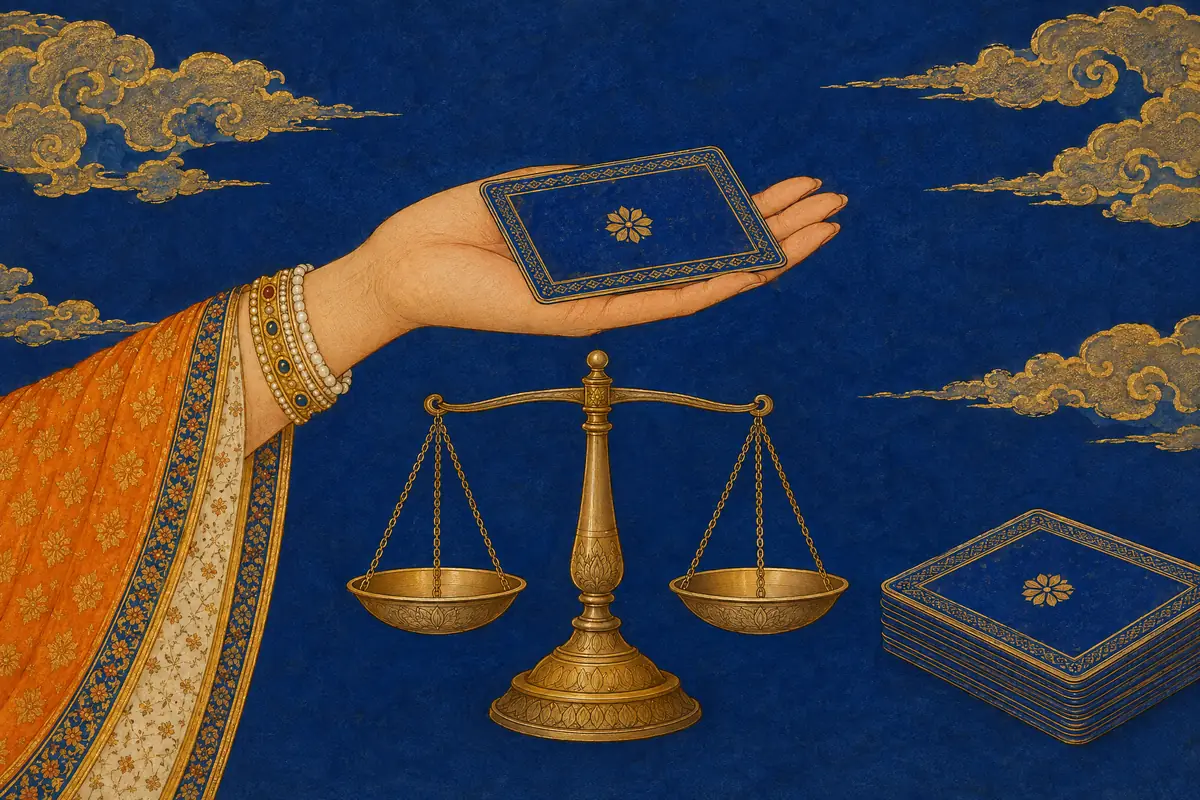
A direct answer with its reason. Upright cards lean yes, reversed cards ask for a step first, and the card always says why.
कारण सहित सीधा उत्तर। सीधे कार्ड हाँ की ओर झुकते हैं, उलटे कार्ड पहले एक कदम माँगते हैं, और कार्ड सदा कारण बताता है।
Positions · स्थान
The answer and its reason उत्तर और उसका कारण
How it is read
Each card is read in its position from the TarotPandit library: the card speaks, the position, the cards together, and practical guidance, in English and Hindi, closing with a synthesis.
The guide
When to use this spread
Use this spread for one decision you can act on soon: send the application or hold it, accept the invitation or decline. Orientation gives the lean, but the card's own nature has the last word. An upright Hanged Man still says wait. An upright Tower says no to the plan in its present form. Many cards answer yes with a condition attached, and that condition is usually the most useful thing the reading gives you. Reframe before you shuffle if the question bundles two choices into one sentence or asks what another person feels. Ask about your own move instead, so that "Will he call?" becomes "Should I call him?" For a choice between two real roads, lay the decision spread. A situation that needs its history read is better served by the past, present, future spread.
The numbers match the positions listed alongside
By hand
How to lay it out
Write the question down first, as one sentence with one verb in it. Hold that sentence in mind while you shuffle, cut once, and draw a single card. Turn it sideways, like the page of a book, so the orientation is kept. Before you look up anything, note two things in order: whether the card is upright or reversed, and what its figure is doing. Then read. Do not draw again for the same question on the same day.
What each position asks
1
The answer and its reason उत्तर और उसका कारण
This one card answers on two levels, and you should read both before you speak. First comes the lean: upright tends toward yes, reversed toward a step that has to come first. Then comes the reason, which is the card's own scene, and it tells you what the answer depends on. When the reason and the lean disagree, as with an upright card of rest or waiting, trust the reason.
One reading, start to finish
A worked example
A 46-year-old homemaker in Indore whose neighbour has proposed that they start a tiffin service together from their two kitchens.
"Should I start the tiffin service with my neighbour?"
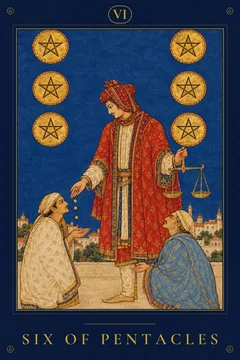
Upright, the Six of Pentacles leans yes, and its scene supplies the condition. A merchant in a red robe holds a small pair of scales level in one hand and lets coins fall from the other into the cupped palms of a kneeling figure. A second figure kneels on his other side with hands raised, and no coins are falling toward him yet. In a partnership of two kitchens, that second figure is the lesson in the picture: one partner served, the other left waiting. The library's answer for this card is "yes, if the exchange is fair", and that is the reading here. Yes to the tiffin service, provided the scales are set before the first order goes out: who buys the vegetables and how each payment is divided.
Synthesis
A single card has no neighbour to talk to, so read it against its own number and suit. Six follows the hardship of the fives. The Five of Pentacles shows two poor figures passing a lit church window in the snow; in the Six the coins are moving again, given by someone who now has enough to give. Pentacles are the suit of Earth, of money and daily labour, and a tiffin service could hardly sit closer to them. The Golden Dawn calls this card the Lord of Material Success and assigns it the Moon in Taurus, where the Moon is exalted. All of that supports a yes. The condition comes from the scales. Reversed, the same card would have said "not on these terms", and the distance between those two answers is a written agreement. So the honest answer is yes, if the arrangement is weighed before it begins; goodwill makes a poor contract once the first quarrel arrives. Her next step is to sit with her neighbour this week and put the terms on one sheet of paper, including what happens when one of them has to travel for a family function, and then agree a trial month with a small number of regular customers before they take on more.
Before you lay it
Common mistakes
Asking the same question again because you disliked the answer. The second draw answers a different question, how badly you want a yes, so work with the first card's condition instead.
Reading orientation alone and ignoring the scene. Look at what the figure is doing, because an upright Four of Swords, its knight lying still on a tomb, says rest first however it lands.
Asking about another person's feelings or private choices. Ask about your own action, which the card can speak to: "Should I raise this with her?" in place of "Does she want to?"
Bringing a medical or legal decision to a one-card yes or no. Take that decision to a doctor or a lawyer, and use the card, if at all, to look at the attitude you bring to it.
It is as clear as the question you bring. One answerable question about your own action gets a readable card; a vague or doubled question gets a vague one. Treat the condition the card names as the part to rely on, because that is the part you can act on.
Which tarot cards mean yes and which mean no?
Most upright cards lean yes and most reversed cards ask for a step first, but a card's nature can overrule its orientation. Cards of waiting, such as the Hanged Man and the Seven of Pentacles, say not yet even upright, and the upright Tower says no to the plan as it stands. Every card page in the /cards library gives its yes-or-no answer for both orientations.
Can I ask tarot a yes or no question about timing?
The card makes a poor calendar. Ask "Is now the right time to apply?" in place of "When will I get the job?" and the card has something it can answer.
How does the Yes or no spread work?
You ask your question, shuffle, and choose 1 card. Each card is read in its position, then the reading closes with a synthesis that joins them.
Is the reading free?
Today's card, yes or no, past-present-future and the Celtic Cross are free, three readings a day without an account. The other spreads are part of Premium.
What does a reversed card mean?
A reversed card is the same energy turned inward, delayed or asked for differently. TarotPandit never reads it as a closed door: every reversal names a step.
Are the readings in Hindi?
Every reading comes in English and Hindi. Use the language button to choose which leads.