The classical timeline: where you were, where you stand, and where the present course leads if nothing changes.
पारंपरिक समय-रेखा: आप कहाँ थे, कहाँ खड़े हैं, और यदि कुछ न बदले तो वर्तमान मार्ग कहाँ ले जाता है।
Positions · स्थान
Past अतीत
Present वर्तमान
Future भविष्य
How it is read
Each card is read in its position from the TarotPandit library: the card speaks, the position, the cards together, and practical guidance, in English and Hindi, closing with a synthesis.
The guide
When to use this spread
Choose this spread when a situation already has a history and you want to see where it is going: a move to a new city, or a job that has gone stale. It is the best first spread for a student, because three cards in a line read like a sentence, and the student learns to join cards before learning to juggle ten. It handles one thread at a time. Two people and the bond between them need the love and relationship spread. A choice between two roads needs the decision spread, since a line in time cannot compare alternatives. When other people and hidden pressures are pulling at a matter, lay the Celtic Cross spread instead.
The numbers match the positions listed alongside
By hand
How to lay it out
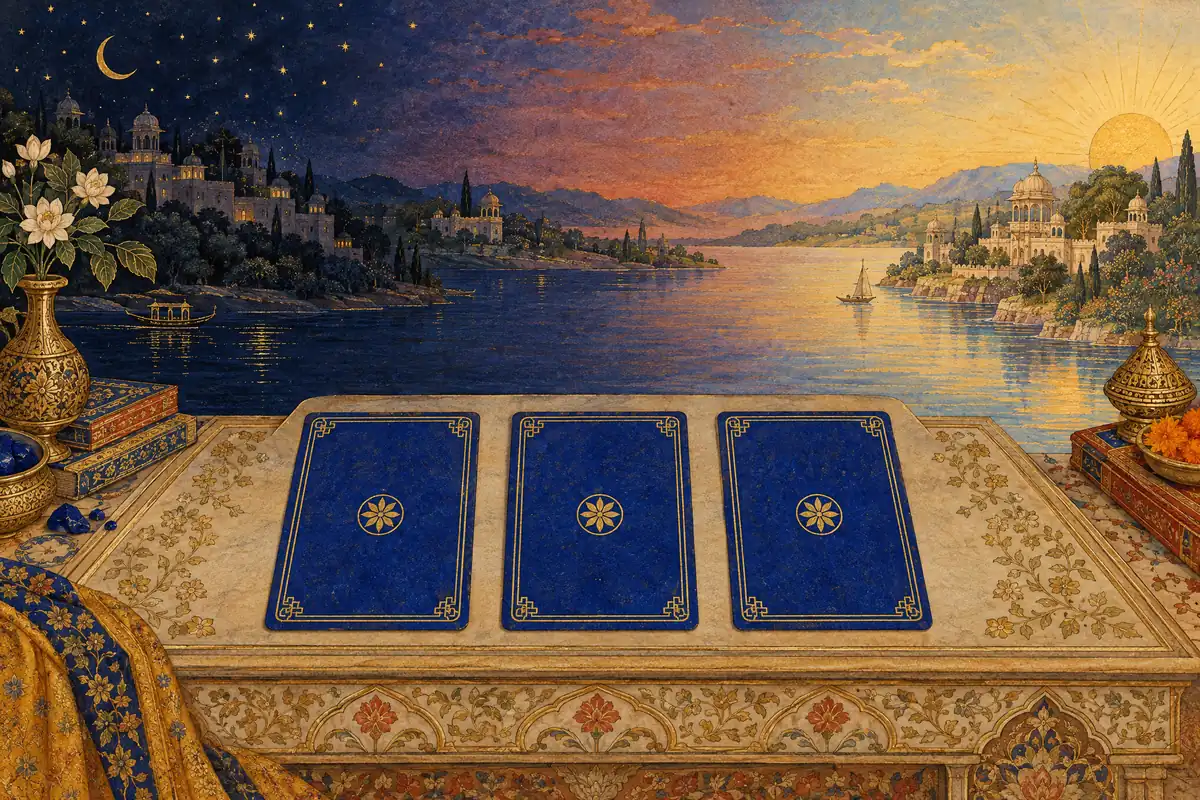
Lay three cards in a row from left to right, as you see them across the table: the past on your left, the present in the centre, the future on your right. The row reads like a line of print, which is why time runs left to right. Leave a finger's width between the cards. Turn all three, sideways so their orientation holds, before you read any of them, and look at the line as a whole for a moment. Then read from left to right.
What each position asks
1
Past अतीत
The past card names what brought the question into being, usually within the last year or two, not the whole of a life. It sits on the left because the row reads like a sentence and this is its opening clause. Look for what has been carried forward from it, a lesson learned or a habit that outlived its use.
2
Present वर्तमान
The centre card is the hinge of the spread and usually the one you can act on. It describes where you stand now, including the attitude you bring, and that attitude is often the one thing in the reading you can change today. If it comes reversed, look for energy held back or turned inward and ask what would let it out.
3
Future भविष्य
The right-hand card shows where the present course leads over the coming months. It shows a direction, and directions can change, which is why it sits after the present card and depends on it. Read it in the light of the centre: a strong future after a reluctant present is a promise that asks for effort.
One reading, start to finish
A worked example
A 33-year-old nurse from Kottayam who moved to Bengaluru eighteen months ago after a broken engagement, with a cousin's help, and now works night shifts at a private hospital.
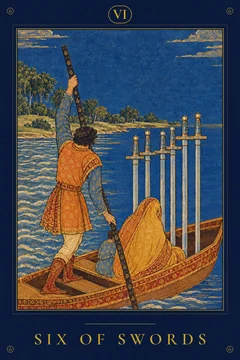
A ferryman poles a narrow boat toward a wooded shore, carrying a woman wrapped in a gold mantle, head bowed, a child at her side, with six swords standing upright in the bow. That is the move from Kottayam, drawn with some accuracy. She did not leave her troubles behind; they came along in the boat, but they stopped steering. She is not holding the pole: someone else got her across, which fits the cousin who found her a room and a job. Look at the water too: broken into small waves on one side of the boat, smooth ahead of the bow. Upright, the card says the crossing was made, and made soundly.
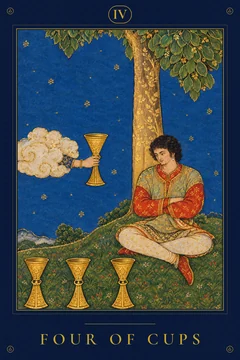
Upright, this card shows a young man under a tree, arms folded, staring at three cups on the grass while a hand from a cloud offers a fourth he will not look at. Reversed, the scene turns: he has looked up. The library follows Waite here and reads novelty and new instruction. Eighteen months of night shifts can produce exactly the flatness of the upright card, and the reversal says that flatness is breaking. Something has been offered and this time she has noticed it, most likely the critical-care course her ward in-charge mentioned last month. The card's counsel is to act while the interest is warm.
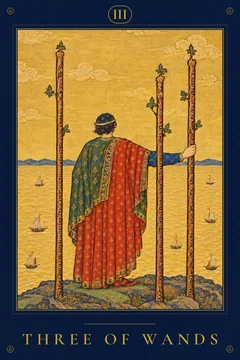
A man in a red robe stands on a cliff with his back to us, one hand on a planted staff, watching small ships cross a golden sea. Set him beside the woman in the first card. She was carried over the water; he stands above it and sends his own ships out. The Golden Dawn calls this card the Lord of Established Strength, and it describes enterprise already launched, with returns arriving in their own time. If she takes up the offer in the centre, the course leads to wider reach: a specialised role, and perhaps the overseas posting she has half-considered since nursing college. The card asks for foresight, so this is the season to get papers and skills ready before the ships return.
Synthesis
The elements move from Air in the past to Fire in the future, with Water between them, so the story runs from a decision of the head, through a long season of feeling, toward action. Then follow the water itself, because it runs through every picture. She is carried over it on someone else's pole in the Six of Swords. By the Four of Cups it has been poured into cups she stopped tasting, and in the Three of Wands it opens into sea with her own ships on it. There are no Major Arcana in the line, which places the matter within ordinary choices; nothing here is larger than her own next move. The reversed centre card is the hinge. Upright, the Four of Cups would have shown her still sulking under the tree, and the Three of Wands would read as a horizon she was not ready for. Reversed, she has looked up, and the future card follows from that look. So the plain answer is that her life in Bengaluru is moving out of recovery and into growth, on the condition that she takes the offer she has already noticed. Her next step is to ask her ward in-charge for the application form for the critical-care course this week, before the interest goes flat again.
Before you lay it
Common mistakes
Reading the future card as fixed. Read it as the direction the present card is heading, and change the present if you dislike where it points.
Stretching the past card back to childhood. Keep it to the events that shaped this question, usually the last year or two, unless the question itself reaches further.
Reading the three cards as three separate fortunes. Say aloud how the past card produced the present one and how the present leads to the future, as one sentence.
Using the spread to choose between two options. A line in time cannot compare two roads, so lay the decision spread for that kind of question.
How far back and how far ahead does a past present future tarot reading look?
There is no fixed rule. A practical span is the last year or two for the past and the next few months for the future. If you need a different span, put it in the question before you shuffle, for example "since I changed jobs" or "over the next three months".
Can I use the past present future spread for love or career questions?
Yes, for any question with a history behind it. For two people and the bond between them, the love and relationship spread has positions built for the purpose, and the career spread does the same for work.
What should I do if the future card is a difficult one?
Look back at the present card, because that is where the future is still being decided. A difficult future card names the cost of the present course, and the centre card shows what to change. Act on it, and lay the spread again in a month.
How does the Past, present, future spread work?
You ask your question, shuffle, and choose 3 cards. Each card is read in its position, then the reading closes with a synthesis that joins them.
Is the reading free?
Today's card, yes or no, past-present-future and the Celtic Cross are free, three readings a day without an account. The other spreads are part of Premium.
What does a reversed card mean?
A reversed card is the same energy turned inward, delayed or asked for differently. TarotPandit never reads it as a closed door: every reversal names a step.
Are the readings in Hindi?
Every reading comes in English and Hindi. Use the language button to choose which leads.