Five cards for two people: you, them, the bond between you, what stands in its way, and the path that strengthens it.
दो लोगों के लिए पाँच कार्ड: आप, वे, आपके बीच का बंधन, उसके मार्ग की बाधा, और वह मार्ग जो उसे दृढ़ करता है।
You
Them
The bond
The obstacle
The path
Premium spread
Five cards for the two of you.
The Love and relationship spread is part of Premium. Premium opens every spread, unlimited, with the five areas of life on every card and a sealed PDF of each reading.
₹299 a month, or ₹1,999 a year (save 44%), less than ₹6 a day
Each card is read in its position from the TarotPandit library: the card speaks, the position, the cards together, and practical guidance, in English and Hindi, closing with a synthesis.
The guide
When to use this spread
Lay the love spread when there is a particular person and a bond already in play: a marriage, an engagement, or a courtship that has gone quiet. The middle position needs two real people to describe, so it suits a question about this relationship far better than a question about love in general. If you are single and asking about your own pattern, the past, present, future spread on your last relationship will teach you more. For a couple who want each partner's view laid out side by side, the relationship cup spread goes further. Read the spread for your own part in the bond, since the Them card shows how the other person is meeting it and cannot stand in for asking them.
The numbers match the positions listed alongside
By hand
How to lay it out
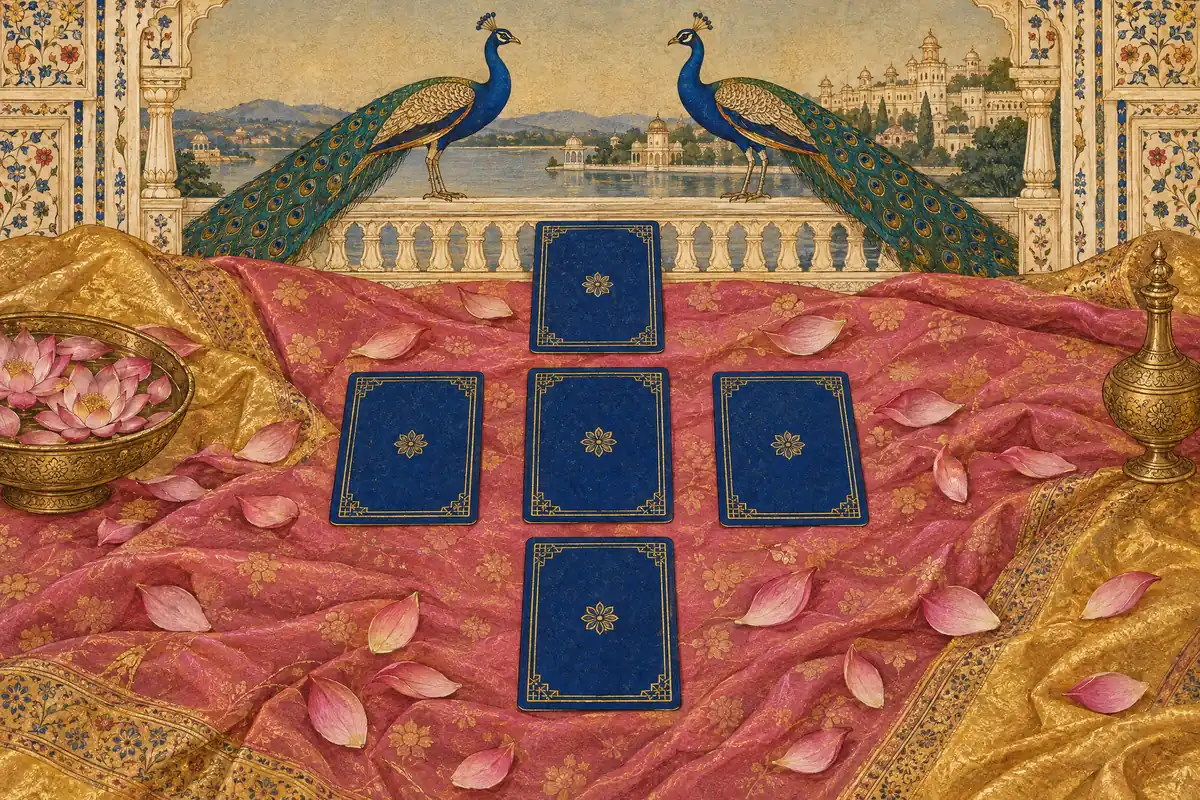
Lay the first card, You, on your left and the second, Them, on your right, with a card's width of space between them. The bond goes into that space, because it belongs to neither person alone. Place the obstacle above the bond and the path below it, so the five cards make a plus sign with the bond at its centre. Read across first, you and them and what joins you, then down from the obstacle through the bond to the path.
What each position asks
1
You आप
The first card shows how you are meeting this relationship now, what you bring and what you hold back. It comes first and sits on your side of the table because the only part of a bond you can change directly is your own. A reversed card here usually means feeling turned inward, felt and not shown.
2
Them वे
The second card shows how the other person is meeting the bond, as far as the cards can see it from your question. Read it as their present manner and stance, and leave their private thoughts to them. Set it against the first card, element against element and pace against pace.
3
The bond बंधन
The centre card describes what exists between you, which is why it sits between the two of you on the table. A strong card here with weaker cards on either side means the connection is sound and the two people are struggling to meet it. Read it as the present health of the relationship, which can change.
4
The obstacle बाधा
Above the bond is what presses on it, and it may come from either person, from the families or from circumstance. The suit often shows its source: Cups point to feeling, Pentacles to money and the practical life, Swords to words and thought, Wands to will and temper. Name the obstacle precisely, because a named obstacle can be worked on.
5
The path मार्ग
Below the bond is the way forward that strengthens it. It is advice, so read it as something one or both of you can begin soon. If it comes reversed, the path is still there and the card is pointing at the manner in which you are walking it.
One reading, start to finish
A worked example
A 31-year-old software tester in Hyderabad, engaged for four months to an engineer in Pune whom her family introduced; they have met in person four times and talk mostly by video call.
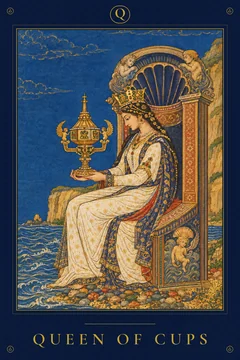
A crowned queen sits at the edge of the sea gazing into a lidded cup with angel-shaped handles, and whatever she knows stays inside it. Reversed, the card shows feeling that has lost its shore. Here is a woman who feels a great deal about her engagement and says little of it, on calls that are short and often have a parent within earshot. She reads every pause as a message. The library's counsel for this card in love is to speak the feelings and keep your own shore. For her that means saying on the next call the sentence she has rehearsed three times and not yet said.
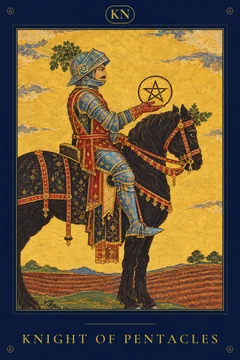
An armoured knight sits still on a heavy black horse, a coin held out on his open palm, oak leaves on his helmet, ploughed fields behind him. Waite calls the horse slow, enduring and heavy, and that is a fair portrait of how this man meets the engagement. He has worked out her commute from three Pune neighbourhoods and started a joint list of what the flat will need. He says little about feeling. In love this card is sincere and serious though slow to declare, and its coin is held out where it can be used. His care takes the form of plans.
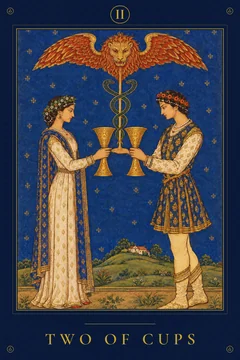
A young woman and a young man face each other, each holding out a cup at the same height, and between the cups rises a staff twined with two serpents and crowned by a winged lion's head. Behind them a house stands on a green hill. Upright, this is a pledge made between equals, and the library counts it among the most hopeful cards for an engagement. Look at the levels. The cups are equal. Whatever each of them is unsure of privately, what stands between them is already in balance, and the house on the hill is the life it can grow into.
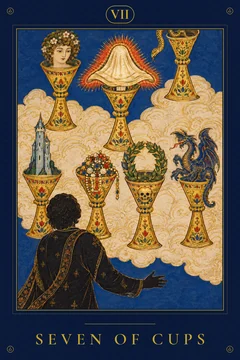
A dark figure stands with his back to us before seven cups floating on a cloud, a tower in one, jewels in another, a dragon in the last. Each vision shines and none of them stands on the ground. For a couple who have met four times and spoken mostly through a screen, this is the obstacle exactly: each is partly relating to a person assembled from short calls and family descriptions. The card asks them to separate the image from the person, and that needs time spent together on solid ground.
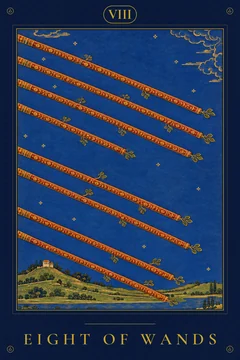
Eight leafing wands fly in parallel across a blue sky toward a green country with a house and a river, and there is no person anywhere in the picture. Upright, it is swift messages arriving. Reversed, the flight is crossed and the messages scatter. Their relationship already runs on messages, dozens a day, and the reversal says that more of them will not help. The library's counsel here is to speak face to face and give the one matter that most needs to land a clear date. The path runs through a meeting, planned and soon, where nothing has to pass through a phone.
Synthesis
Three of the five cards are Cups, so this reading has no shortage of feeling. The one Earth card is him, and TarotPandit reads the Knight of Pentacles as the Air of Earth, a mind turned toward practical things. Her Queen, reversed and without a shore, needs exactly the solid ground he stands on, which is a better match than either of them suspects. The only Fire in the spread is the path, and the placement matters: feeling and steadiness are present already, and what is missing is action. Now follow the cups. Hers is lidded. The seven in the obstacle float on a cloud. Only the two in the bond are held out in the open, at the same height, and that makes the bond the most honest card on the table. There are no Major Arcana, so this is a matter of everyday conduct between two people and well within their reach. The plain answer to her question is that she stands on firmer ground than she fears. He is serious in his slow way and the pledge between them is balanced. The haze comes from distance, and from imagining where she could be asking. Her next step is to book a weekend in Pune before the families meet to fix the date, and to ask him in person one direct question: what does he picture for their first year?
Before you lay it
Common mistakes
Using the Them card to read someone's private thoughts. Read it as the way they are meeting the bond as it appears to you, and ask them directly about the rest.
Laying the spread for a person you barely know or have not yet met. The Them card needs someone real to describe, so for love in general lay the past, present, future spread on your own pattern.
Treating the obstacle card as the other person's fault. Look at its suit and find where it comes from before assigning it to anyone, then work on the part that is yours.
Reading the bond card as the final verdict on the relationship. It describes the present health of the connection, so pair it with the path card and act on what the path asks.
Premium
The Love and relationship spread and every other spread, unlimited
Can a love tarot spread tell me what my partner feels?
It can show how they are meeting the relationship as the cards describe it, through the Them position, but it cannot replace a conversation with them. Use the Them card to decide what to ask, and then ask.
Can I use the love tarot spread if I am single?
The Them and bond positions need a particular person, so the spread works best once someone is in the picture. While you are single, the past, present, future spread laid on your last relationship, or the today's card spread card kept as a practice, will tell you more about your own pattern.
How often should I do a love tarot reading about the same person?
Once on a given question, and then act on the path card for a few weeks before laying it again. Reading the same bond every few days feeds the problem in the example above: more imagining, less meeting.
How does the Love and relationship spread work?
You ask your question, shuffle, and choose 5 cards. Each card is read in its position, then the reading closes with a synthesis that joins them.
Is the reading free?
Today's card, yes or no, past-present-future and the Celtic Cross are free, three readings a day without an account. The other spreads are part of Premium.
What does a reversed card mean?
A reversed card is the same energy turned inward, delayed or asked for differently. TarotPandit never reads it as a closed door: every reversal names a step.
Are the readings in Hindi?
Every reading comes in English and Hindi. Use the language button to choose which leads.