TarotPanditby Pandit Rahul Kaushl
Readings · Premium

Relationship cup संबंध-पात्र

Both sides of one bond: how each of you sees it, what you share, what divides you, what each of you needs, and the future of the bond.

एक बंधन के दोनों पक्ष: आप दोनों उसे कैसे देखते हैं, क्या साझा है, क्या बाँटता है, दोनों को क्या चाहिए, और बंधन का भविष्य।

Premium spread

Both sides of one bond.

The Relationship cup spread is part of Premium. Premium opens every spread, unlimited, with the five areas of life on every card and a sealed PDF of each reading.

₹299 a month, or ₹1,999 a year (save 44%), less than ₹6 a day
Positions · स्थान
  1. Your view आपकी दृष्टि
  2. Their view उनकी दृष्टि
  3. What you share जो साझा है
  4. What divides जो बाँटता है
  5. What you need आपको क्या चाहिए
  6. What they need उन्हें क्या चाहिए
  7. The future of the bond बंधन का भविष्य
How it is read

Each card is read in its position from the TarotPandit library: the card speaks, the position, the cards together, and practical guidance, in English and Hindi, closing with a synthesis.

The guide

When to use this spread

This spread looks at one bond from both sides at once, so it works for any relationship that matters to you: a partner, a parent, a grown child, a close friend, a business partner. Use it when the bond is under strain or at a turning point and you want to see what each of you brings and what each of you needs. Lay it for a living relationship you can still act on. If the question is a new romance, or whether someone is interested, the love spread is shorter and more direct. If what troubles you is your own pattern across many relationships, the shadow-work spread looks inward where this one looks between.

How to lay the Relationship cup spread: 7 cardsThe seven cards make a goblet as seen from your chair. Card one, your view, goes at upper left and card two, their view, at upper right; card three, what you share, sits between them, so the rim reads you, the shared ground, them. Card four, what divides, goes in the centre well below the rim as the stem, the narrowest part of a cup and the place it breaks if it ever breaks. Cards five and six fill the bowl, your need under your view and theirs under theirs. Card seven, the future, is the foot the whole cup stands on.1234567YOU SIT HERE
The numbers match the positions listed alongside
By hand

How to lay it out

The seven cards make a goblet as seen from your chair. Card one, your view, goes at upper left and card two, their view, at upper right; card three, what you share, sits between them, so the rim reads you, the shared ground, them. Card four, what divides, goes in the centre well below the rim as the stem, the narrowest part of a cup and the place it breaks if it ever breaks. Cards five and six fill the bowl, your need under your view and theirs under theirs. Card seven, the future, is the foot the whole cup stands on.

What each position asks

  1. Your view आपकी दृष्टि

    How you see the bond at present, including what you would not say aloud to the other person. It sits on your side of the rim. Be honest with this card even when it shows you guarded or tired, because the rest of the reading leans on it.

  2. Their view उनकी दृष्टि

    How the other person sees it, as far as the cards can show. It sits opposite yours on the rim, and the first thing to read is the gap or the agreement between the two views. Treat it as a perspective to weigh, never as proof of what someone thinks.

  3. What you share जो साझा है

    The common ground, whether values, history, work or affection, whatever still holds the two of you together. It sits in the middle of the rim, inside the cup, because it is what the bond contains. A strong card here is the reason to repair before anyone walks away.

  4. What divides जो बाँटता है

    The point of friction, placed at the stem because the stem is where a cup snaps. It may be an old quarrel, or a plain practical matter such as money. A reversed card here often shows a division that is already softening.

  5. What you need आपको क्या चाहिए

    What you require for the bond to work for you, which is often different from what you want. It sits under your view because it answers it. Read it as something you can ask for, or give yourself.

  6. What they need उन्हें क्या चाहिए

    What the other person requires, placed under their view. Compare it with your own need. Two needs that can be met together are good news, and two that pull apart show where the bargaining has to happen.

  7. The future of the bond बंधन का भविष्य

    Where the bond goes if both needs are taken seriously. It is the foot of the cup, the base everything else rests on. Read it last, with the two need cards beside it, because the future here depends on them.

One reading, start to finish

A worked example

A 44-year-old chartered accountant in Indore who has run a two-partner practice with a college friend for eleven years.

"Can my partner and I keep the firm together, and what would it take?"
1 · Your view

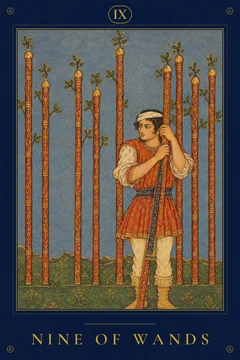
Nine of Wands दंडों का नौ

A young man with a bandaged head grips one wand and glances sideways, eight more wands planted behind him like a fence. This is how he sees the partnership: he has held the post, carried the larger audit clients through two hard years, and he is tired and on guard. Waite reads strength in opposition, a person who meets an attack boldly. The card is fair to him. It also shows a man who now treats every suggestion from his partner as an attack on the fence.

2 · Their view

Eight of Cups प्यालों का आठ

A traveller in a red cloak walks toward the mountains under an eclipsed moon, his back to eight stacked cups with a gap in the upper row. His partner sees a practice that works and no longer feeds him. Nothing has been smashed, and the cups still stand. Waite reads a matter in decline, or the realisation that what seemed important matters little. Look at the gap in the upper row. Something the partner hoped to build was never built, and that empty place is what he is walking away from.

3 · What you share

Three of Pentacles मुद्राओं का तीन

A sculptor on a bench carves a church arch while a monk and a hooded patron hold the drawings up to him. What these two share is the craft itself: a standard of work their clients trust, and eleven years spent building a practice to that standard. The card shows three parties agreeing on one plan, and here the third party is the clientele. It is the strongest card in the reading and the main reason to repair the partnership before anyone talks of dissolving it.

4 · What divides

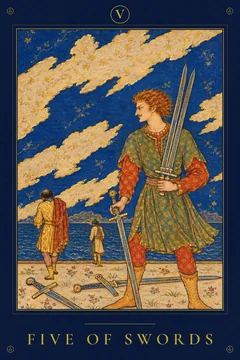
Five of Swords तलवारों का पाँचReversed

Upright, a man with a thin smile gathers swords while two defeated figures walk away toward the sea. Two years ago the querent won an argument. His partner wanted to start an advisory service for small businesses, and he refused on grounds of risk; he was right on paper and lost goodwill in the process. Reversed, the card points to a quarrel being laid to rest, with Waite's note of burial and the modern reading of amends. The division is softening, and it will soften faster once he names the old argument aloud and says what it cost.

5 · What you need

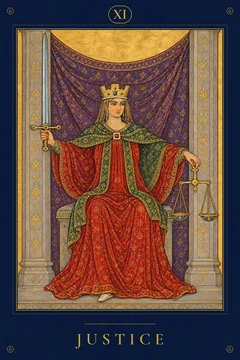
Justice न्याय

A crowned woman sits between two grey pillars, a sword held straight up in one hand and the scales hanging level from the other. He needs fair terms in writing, covering who carries which clients and how profit is shared now that the work has changed shape. Waite reads equity and rightness here. The card asks him to put the whole account on the table, including the part that flatters his partner, and to let a document do the weighing that resentment has been doing.

6 · What they need

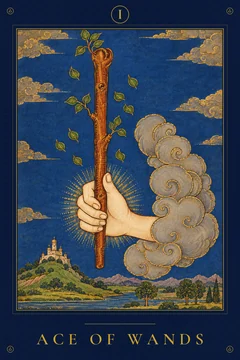
Ace of Wands दंडों का इक्काReversed

A hand from a grey cloud grips a living wand that sprouts fresh shoots, a castle on a green rise below. Reversed, the spark has not yet caught, and Waite softens the reversal into a joy that is clouded over. The partner needs a beginning. The advisory work he proposed two years ago is still his live idea, and it has had no fuel. The wand is still green, and the card asks for one chosen idea with a date to start it.

7 · The future of the bond

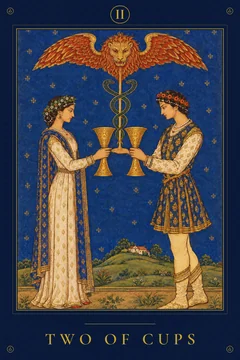
Two of Cups प्यालों का दो

A young woman and a young man face each other with cups held at the same height, and between them rises a staff twined with two serpents and crowned by a winged lion's head. Read outside romance, this is a renewed pledge between equals, and the Two's working meaning covers co-founders and agreements made on fair terms. The staff is the caduceus of Hermes, an old emblem of trade, which suits two accountants well. The cups are level, and the future of this bond depends on both needs being met: his terms and his partner's spark.

Synthesis

Start at the rim. The two views are a Nine and an Eight, both near the end of their suits, so each man feels he has already given this practice most of what he has. One is braced at his post and the other is quietly walking off, and neither has told the other. The shared card between them is the strongest in the spread: the Three of Pentacles says the work, and the trust clients place in it, is intact. Now the stem. The Five of Swords is Air, and so is Justice in the querent's need, which tells you that the break began with words and will be mended with words, an argument won two years ago answered by a fair agreement written now. Fire appears twice, in the querent's view and in his partner's need, guarding on one side and longing to begin on the other. The two reversals tell one story, because the idea that lost the argument is the spark that has not caught. The foot of the cup is the Two of Cups, upright and level. So the plain answer is yes, the firm can hold, on two conditions met together. His next step is to sit down with his partner, acknowledge the advisory idea he turned down, and propose a written trial of it alongside a revised partnership deed.

Before you lay it

Common mistakes

  • Assuming this spread is only for lovers. Lay it for any bond you want to understand from both sides, a parent, a friend or a business partner included.
  • Reading their view as a fact about what the other person thinks. Treat it as a perspective worth testing, and test it by asking them.
  • Reading the two need cards separately. Lay them side by side and look for the need that can be met together, since that is where the future card's promise lives.
  • Laying it about someone you no longer have contact with, as a way of watching them from afar. Lay it for a bond you can still act on, and keep the focus on what you can change.
Premium
The Relationship cup spread and every other spread, unlimited
See Premium
FAQ

Questions people ask

Can I use the relationship cup spread for family or work relationships?

Yes, and it often works better there than for a new romance, because both people already hold a clear view of the bond. The positions are written for any two people with a shared history. Name the person and the relationship in your question so that the cards are read in the right register.

What if their view and my view are completely different?

That happens often, and it is useful. The distance between the two rim cards is usually the first thing worth talking about. Begin that conversation from the shared card, since it names the ground you both still stand on.

How does the Relationship cup spread work?

You ask your question, shuffle, and choose 7 cards. Each card is read in its position, then the reading closes with a synthesis that joins them.

Is the reading free?

Today's card, yes or no, past-present-future and the Celtic Cross are free, three readings a day without an account. The other spreads are part of Premium.

What does a reversed card mean?

A reversed card is the same energy turned inward, delayed or asked for differently. TarotPandit never reads it as a closed door: every reversal names a step.

Are the readings in Hindi?

Every reading comes in English and Hindi. Use the language button to choose which leads.