What you carry unseen: the mask you show, the shadow behind it, its hidden gift, its cost, and the way to bring the two together.
जो आप अनदेखा ढोते हैं: दिखाया गया मुखौटा, उसके पीछे की छाया, उसका छिपा उपहार, उसकी कीमत, और दोनों को जोड़ने का मार्ग।
The mask
The shadow
Its gift
Its cost
Integration
Premium spread
What you carry unseen.
The Shadow work spread is part of Premium. Premium opens every spread, unlimited, with the five areas of life on every card and a sealed PDF of each reading.
₹299 a month, or ₹1,999 a year (save 44%), less than ₹6 a day
Each card is read in its position from the TarotPandit library: the card speaks, the position, the cards together, and practical guidance, in English and Hindi, closing with a synthesis.
The guide
When to use this spread
Shadow work is a reflective practice: looking honestly at the parts of yourself you usually keep out of view, such as anger you swallow or a strength you were taught was impolite. The term shadow comes from the psychologist Carl Jung. Choose this spread on a calm day, with an hour free and a notebook, when you keep noticing the same pattern in yourself. It is a tool for self-reflection and works alongside counselling, never in place of it. If a question brings up distress that stays with you for days, or touches on harm done to you, put the cards aside and speak with a qualified counsellor or psychologist. For a question about a relationship between two people, the relationship cup spread serves better.
The numbers match the positions listed alongside
By hand
How to lay it out
Lay the mask at the top, where the world meets it first. The shadow goes directly beneath it, behind the face. Lay its gift to the right of the shadow and its cost to the left. Integration goes at the bottom, under the shadow, as the ground the others settle into. The vertical line from mask through shadow to integration is the spine of the reading, and the gift and the cost are its two arms. Turn one card at a time and write a line about each before you turn the next.
What each position asks
1
The mask मुखौटा
The face you show: the role other people rely on and praise you for. It sits at the top because it is what the world meets first. Read it with respect, since a mask is usually a real strength worn too constantly, and this spread never asks you to tear it off.
2
The shadow छाया
What sits behind the mask, kept out of view because at some point it seemed unwelcome. Shadow here does not mean bad. It is often anger, need, ambition or plain tiredness that never received permission, so read the card gently and ask where you have glimpsed this quality in yourself, or in someone who irritates you.
3
Its gift उसका उपहार
What the shadow offers once it is acknowledged. Every hidden quality carries a usable strength, and this card names it. If the gift surprises you, the surprise is usually the point.
4
Its cost उसकी कीमत
What keeping the shadow hidden is costing you now, in energy or in honesty with the people close to you. Read it plainly and without blame. It sits opposite the gift because the two together are the reason to do this work.
5
Integration समन्वय
How the mask and the shadow can live together without either one winning. This card sits at the bottom, under the shadow, as the ground for a small and practical change. Turn its advice into one action you can take this week.
One reading, start to finish
A worked example
A 36-year-old marketing manager in Bengaluru, known at work and at home as the one who keeps the peace.
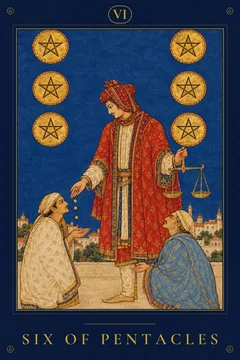
A merchant in a red robe holds a pair of scales in one hand and drops coins into the open hands of a kneeling figure with the other, while a second figure waits. This is the face she shows: the colleague who covers for everyone, the daughter who never refuses a request. Waite reads gifts and gratification. It is a real virtue, and the scales show that she believes she is keeping things even.
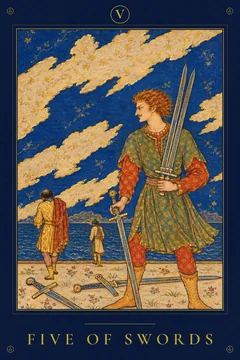
Upright, a red-haired victor gathers swords while two figures walk away toward a grey sea. Reversed, the quarrel has been buried, though resentment can linger after the fighting stops. Behind her generosity sits a quiet scorekeeper: arguments she never had, rehearsed at night, and a wish to be the one who wins for once. The card asks her to admit that the resentment exists, without punishing herself for it. A feeling acknowledged is far easier to carry than one denied.
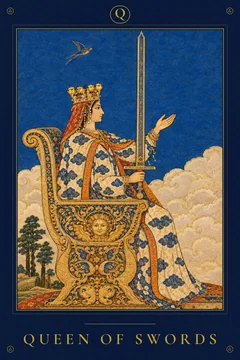
The queen sits in profile with her sword held upright in one hand and the other hand raised and open, a single bird high in the sky behind her. Her gift is the shadow's own energy made clean: the ability to see a situation without illusion and to say no plainly, without cruelty. The swords she buried in the shadow card belong to the same suit as this queen's blade. Queens are Water in our court scheme, so this clarity keeps its warmth.
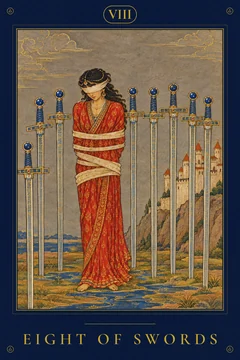
A woman in a red robe stands bound and blindfolded among eight swords, a castle on the cliff behind her. Waite reads temporary confinement. The cost of the hidden resentment is this feeling of being held in place by her own reputation as the one who never refuses. Yet her feet are free and the bindings are loose, which is exactly what the card wants her to notice.
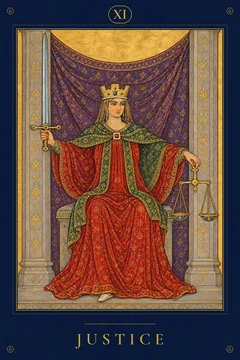
Justice sits squarely between two pillars, sword upright in one hand and level scales in the other. The merchant's scales from the mask return here, held now by someone who weighs both sides, her own included. Integration means fair exchange: giving when she chooses to, and stating her terms when she does not. Waite reads equity and rightness. This week she can write down each request she receives and decide it as if a stranger were judging between her and the person asking.
Synthesis
Begin with the spine. The mask and the integration card both carry scales, the merchant's and then Justice's. The difference between them is the whole reading. The merchant uses his scales to measure out gifts, and Justice uses hers to reach a decision with both sides on the pans. She already owns the instrument. What changes is whether her own needs are allowed onto the other pan.
Now the suits. Four of the five cards are Air, three Swords and Justice, which belongs to Libra. This is work done in thought and in speech, the place where her no gets stuck. Follow the Swords. In the shadow they are buried, and in the cost they bind her; only in the gift, in the Queen's hand, are they held upright. The mask alone is Earth, practical help given in coins and favours, and that is why the mask feels solid and the rest feels like weather.
Only the shadow is reversed. The reversal turns the Five's energy inward, which fits a resentment she has kept to herself, and it suggests the resentment is already halfway to being laid down.
The plain answer: she says yes because the yes protects a role she values and keeps a resentment out of sight. Her step this week is a single sentence, 'Let me check and come back to you tomorrow', used before answering any request. If the reflection stirs older memories that stay heavy for days, that is a good reason to talk it through with a qualified counsellor.
Before you lay it
Common mistakes
Treating the shadow card as proof that something is wrong with you. Read it as a quality that never received permission, and ask what it was trying to protect.
Trying to tear the mask off. Keep what is good in it, and let the integration card show how it can sit alongside the shadow.
Laying this spread when you are already exhausted or upset. Choose a calm day, and if the reading stirs feelings that do not settle within a few days, talk to a qualified counsellor.
Reading someone else's shadow without being asked. Use the spread on yourself, or for a person who has invited you to.
Premium
The Shadow work spread and every other spread, unlimited
No. It is a reflective exercise that can help you notice patterns and put words to them. Therapy is a relationship with a trained professional who can work with what comes up over time. If you are struggling, a qualified counsellor or psychologist is the right first step, and the cards can wait.
What if I dislike the card that falls in the shadow position?
That reaction is common and often useful. Write down exactly what you dislike about the card, then ask where that quality has helped someone you admire. Cards like the Devil or the Tower here name an energy to understand, and the gift card beside them shows what it can become.
How often should I do a shadow-work spread?
Once a month is plenty, and one pattern at a time. Give the integration step a few weeks to work before you lay the spread again on the same question.
How does the Shadow work spread work?
You ask your question, shuffle, and choose 5 cards. Each card is read in its position, then the reading closes with a synthesis that joins them.
Is the reading free?
Today's card, yes or no, past-present-future and the Celtic Cross are free, three readings a day without an account. The other spreads are part of Premium.
What does a reversed card mean?
A reversed card is the same energy turned inward, delayed or asked for differently. TarotPandit never reads it as a closed door: every reversal names a step.
Are the readings in Hindi?
Every reading comes in English and Hindi. Use the language button to choose which leads.