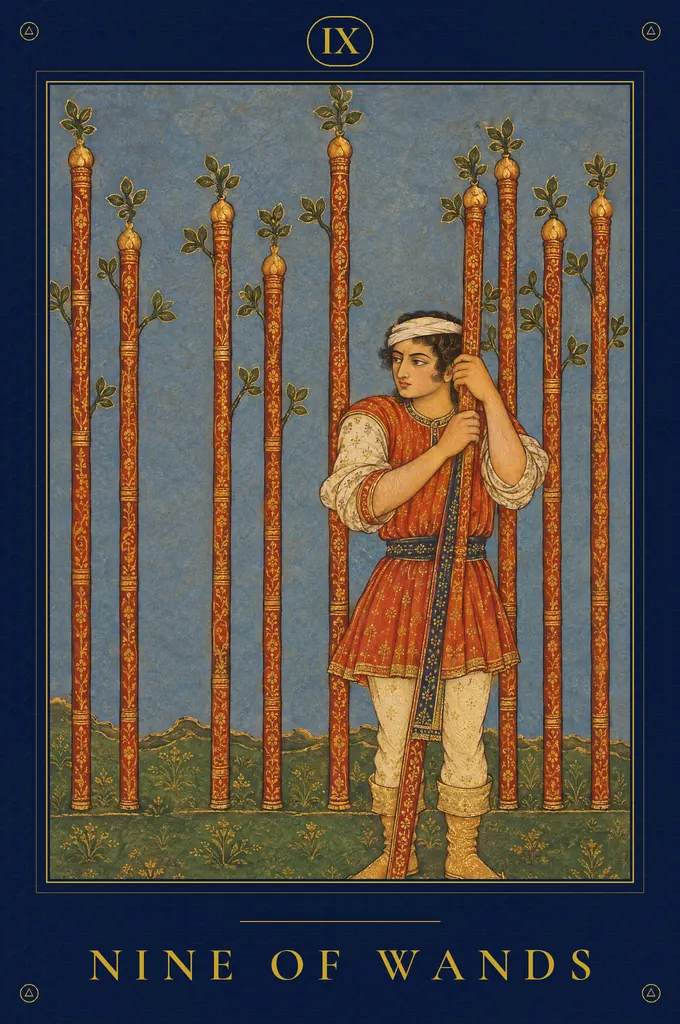
A dark-haired young man, a white cloth bound round his brow, turns his head to his right and looks sideways out of the picture. His body faces us while his attention is elsewhere. Waite describes an expectant look, as if he were awaiting an enemy.
काले बालों वाला एक युवक, माथे पर श्वेत वस्त्र बँधा हुआ, अपना सिर दाहिनी ओर मोड़कर चित्र से बाहर तिरछी दृष्टि से देखता है। उसका शरीर हमारी ओर है, पर ध्यान कहीं और। वेट एक प्रतीक्षारत दृष्टि का वर्णन करते हैं, मानो वह किसी शत्रु की बाट देख रहा हो।
Experience that has cost something. The bandage proves he has already fought; the steady stance proves the fight did not break him. The early Wands had bright confidence. Here courage has been tested, and he knows what a blow feels like.
ऐसा अनुभव जिसकी कीमत चुकाई गई है। पट्टी प्रमाण है कि वह पहले लड़ चुका है, और स्थिर मुद्रा प्रमाण है कि उस लड़ाई ने उसे तोड़ा नहीं। आरंभिक दंडों में चमकीला आत्मविश्वास था। यहाँ साहस परखा जा चुका है, और वह जानता है कि प्रहार कैसा लगता है।
White linen at the head: the wound is in the place of thought. Readers often take it as a memory of past hurt that keeps him on guard.
सिर पर श्वेत वस्त्र: घाव विचार के स्थान पर है। पाठक प्रायः इसे पुरानी चोट की स्मृति मानते हैं जो उसे सजग रखती है।
Pictorial Key, 1910 (an expectant look, as if awaiting an enemy). The bandage as a memory of hurt is a later reading.
पिक्टोरियल की, 1910 (प्रतीक्षारत दृष्टि, मानो शत्रु की बाट देख रहा हो)। पट्टी को पुरानी चोट की स्मृति मानना बाद की व्याख्या है।
Upright, the guard stands for the querent's hard-won resilience: honour it. Reversed, the sideways glance has turned into suspicion of everyone; ask which threat is present and which is only remembered.
सीधा आने पर प्रहरी प्रश्नकर्ता की कठिनाई से अर्जित दृढ़ता है, उसका सम्मान कीजिए। उलटा आने पर तिरछी दृष्टि सब पर संदेह बन गई है। पूछिए कि कौन-सा संकट वर्तमान है और कौन-सा केवल स्मृति।