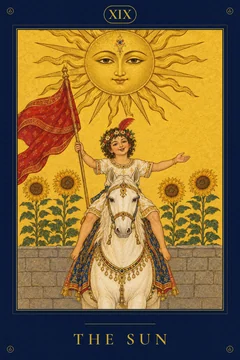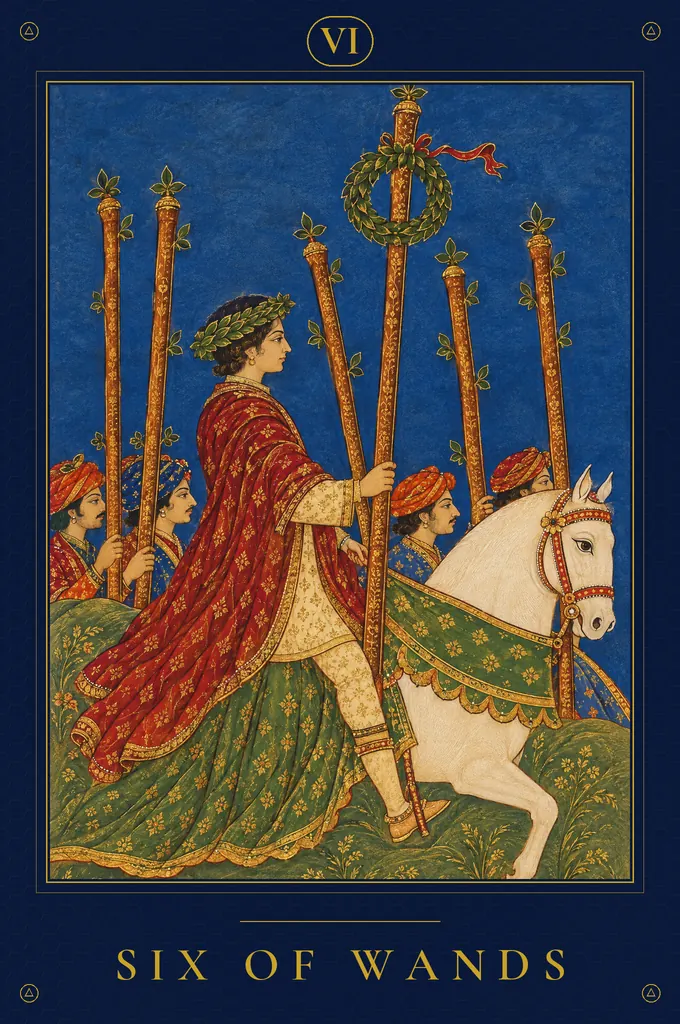
A young man sits upright on horseback, facing right, chin level, gaze ahead. He wears a long red cloak worked in gold that falls over the horse's flank, a cream patterned tunic, yellow hose and a tall boot.
एक युवक घोड़े की पीठ पर सीधा बैठा है, दाहिनी ओर मुख किए, ठोड़ी सम, दृष्टि आगे। वह सुनहरे काम वाला लंबा लाल लबादा पहने है जो घोड़े के पार्श्व पर गिरता है, क्रीम रंग का बेल-बूटेदार अंगरखा, पीले मोज़े और एक ऊँचा जूता।
The victor triumphing. Waite says the card was designed to cover several meanings, and on the surface it is exactly this: a person who has come through the contest and is now honoured for it. His posture is composed and free of boasting.
विजयोत्सव मनाता विजेता। वेट कहते हैं कि यह कार्ड अनेक अर्थों को समेटने के लिए रचा गया था, और सतह पर यह ठीक यही है: एक व्यक्ति जो प्रतियोगिता से पार आया है और अब उसके लिए सम्मानित है। उसकी मुद्रा संयत है, उसमें दंभ का लेश नहीं।
Red and gold for courage and honour, draped wide so that it covers half the horse: the energy of the suit worn as a mantle of distinction.
साहस और सम्मान के लिए लाल और सुनहरा, इतना फैला हुआ कि आधे घोड़े को ढक ले: सूट की ऊर्जा, विशिष्टता के उत्तरीय की तरह पहनी हुई।
Pictorial Key, 1910 (a laurelled horseman; on the surface, a victor triumphing). Golden Dawn: Jupiter in Leo, Lord of Victory.
पिक्टोरियल की, 1910 (लॉरेल-धारी अश्वारोही, जो सतह पर विजयोत्सव मनाता विजेता है)। गोल्डन डॉन: सिंह में बृहस्पति, विजय का स्वामी।
The querent is the rider: accept the recognition graciously. If the card is reversed, they may be riding ahead of the result, so secure the outcome before the parade.
प्रश्नकर्ता ही सवार हैं: मान्यता को शालीनता से स्वीकार कीजिए। उलटा आने पर वे परिणाम से आगे सवारी कर रहे हो सकते हैं, इसलिए जुलूस से पहले परिणाम सुरक्षित कीजिए।