Ten positions laid as a cross and a staff: the heart of the matter, what crosses it, its root, its crown, the near future, you, your world, your hopes and fears, and the outcome.
क्रॉस और दंड के रूप में दस स्थान: विषय का हृदय, जो उसके आड़े आता है, उसकी जड़, उसका मुकुट, निकट भविष्य, आप, आपका संसार, आशाएँ और आशंकाएँ, और परिणाम।
Positions · स्थान
The heart of the matter विषय का हृदय
What crosses it जो उसके आड़े आता है
The foundation नींव
The recent past निकट अतीत
The crown: what may be मुकुट: जो संभव है
The near future निकट भविष्य
You आप
Your environment आपका परिवेश
Hopes and fears आशाएँ और आशंकाएँ
The outcome परिणाम
How it is read
Each card is read in its position from the TarotPandit library: the card speaks, the position, the cards together, and practical guidance, in English and Hindi, closing with a synthesis.
The guide
When to use this spread
Keep the Celtic Cross for a matter with layers, one where other people are involved and the decision will shape the year ahead. Ten cards take time to read well, and the spread repays that time only when the question deserves it. Lay it once on a given matter, then live with the answer for a month before laying it again. A single thread with a history is better served by the past, present, future spread, which is quicker and often enough. For two people and the bond between them use the love and relationship spread, and for a question purely about work, the career spread.
The numbers match the positions listed alongside
By hand
How to lay it out
Lay card 1 face up in the centre and card 2 across it, turned on its side. Then circle the cross: card 3 below it, card 4 to its left, card 5 above, card 6 to its right. Leave a hand's width and build the staff to the right of the cross from the bottom up, card 7 at the foot and card 10 at the top. Sit facing the cross, so the recent past falls on your left and the near future on your right. Read the cross as one picture before you touch the staff.
What each position asks
1
The heart of the matter विषय का हृदय
The first card sits at the centre because everything else is laid around it. It names the situation as it stands, the thing the question is really about, which is not always the thing the querent said. Read it slowly and test every later card against it.
2
What crosses it जो उसके आड़े आता है
Laid sideways across the first card, this is the force running against the heart of the matter. It is turned on its side because it pulls against the situation without replacing it. Even a gentle card in this place is an obstacle, so ask what it blocks or delays.
3
The foundation नींव
Below the cross lies the root, the older ground the matter grew from, often outside the querent's present attention. It sits underneath because foundations are walked on and rarely looked at. If this card quarrels with the heart, the situation is standing on something it has outgrown.
4
The recent past निकट अतीत
To the left of the cross is what has just passed and is still felt. It is the nearest cause, closer in time than the foundation, and usually something the querent can name at once. Look for what it hands on to the near future on the far side of the cross.
5
The crown: what may be मुकुट: जो संभव है
Above the cross sits the best that can come of the matter as things stand, or the aim the querent holds consciously. It is a possibility, which is why the position is named what may be and kept apart from the outcome. Compare it with card 10: when the two agree, the aim is within reach.
6
The near future निकट भविष्य
To the right of the cross is what comes next, in the coming weeks, and it is not the final result. It sits opposite the recent past so that the cross reads from left to right as a short line of time. A reversed card here usually means a delay or a false start, and a false start is still a step.
7
You आप
The staff begins at the bottom with the querent's own stance: how they are meeting the matter. It sits at the foot because the staff is built upward from the person. Court cards often land here, and they describe a manner of acting more than a fixed character.
8
Your environment आपका परिवेश
Second on the staff is the world around the querent, the household and the workplace and the mood of the people in them. Read it as influence, never as blame. Ask how this card presses on card 7 just below it.
9
Hopes and fears आशाएँ और आशंकाएँ
The third card on the staff holds what the querent hopes for and what they fear, and very often these are the same event seen from two sides. Read it both ways before settling on one. It sits just below the outcome because hope and fear shape how the outcome is met.
10
The outcome परिणाम
At the top of the staff is where the matter is heading if the present forces continue. It comes last because it is the sum of the nine before it, and you should be able to trace it back to them. If it surprises you, return to cards 1 and 2 before thinking of drawing more.
One reading, start to finish
A worked example
A 38-year-old chartered accountant in Kolkata whose 71-year-old father wants to retire from the family printing press, which lost its largest textbook contract last year.
"What do I need to understand about taking over my father's press?"
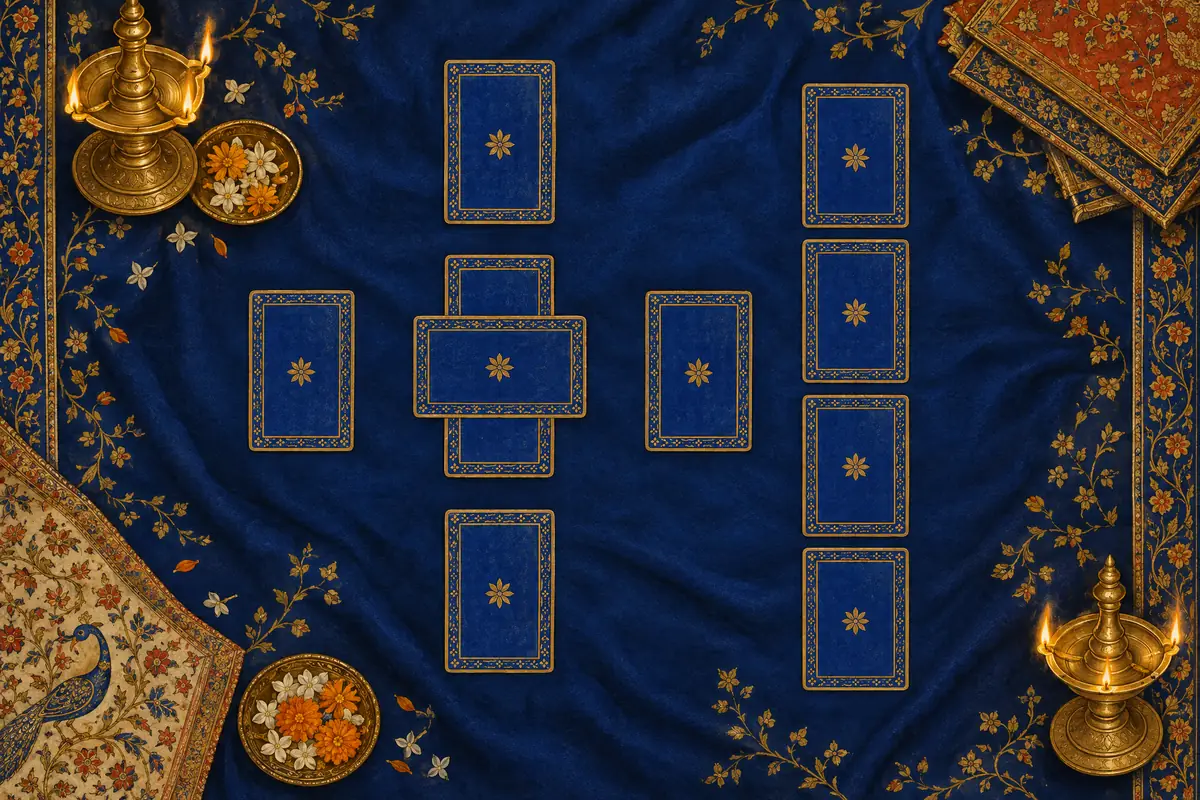
A man bent double carries ten staves toward a house among trees, his face pushed into the bundle so he cannot see where he is going. For two years he has kept his firm by day and the press's books at weekends, and this is what that looks like. The house is close and the field is sown: this stage is nearly over, and the present method will not carry into the next.
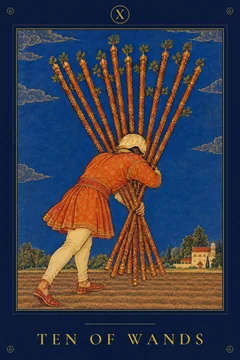
Across the burden sits a blindfolded woman on a stone bench, two swords crossed over her heart, her back to the sea. What keeps the Ten so heavy is the refusal to choose, since while he decides nothing he carries both lives. The truce has bought him time to gather facts, and the card now asks him to set a date.
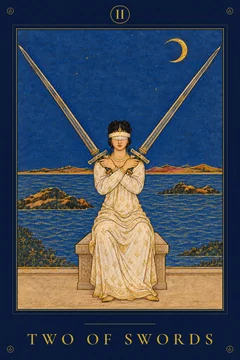
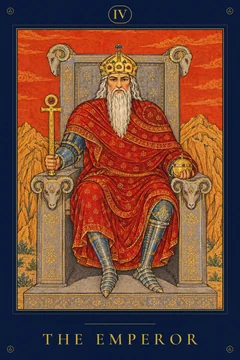
At the root sits the Emperor on his stone throne carved with rams' heads, reversed. The press was built by an Emperor, and its rates and its clients still live in his head. Reversed, the throne is about to stand empty with the rules kept for their own sake; Waite's reversed list also gives benevolence, the father's best gift here if he hands over the keys along with the ledgers.
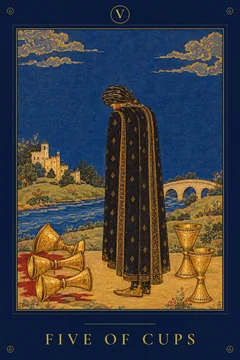
A cloaked figure grieves over three spilled cups. That is the lost textbook contract, still mourned at the dinner table. Behind him two cups stand full and a bridge leads home: the wedding-card trade and the small Bengali publishers who never left.
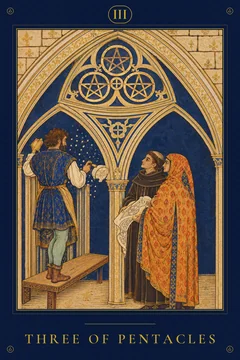
Above the cross a sculptor carves an arch while a monk and a hooded patron hold up the drawings. The best this matter can become is a workshop again, where the craftsman at the stone works to a plan held by others who bring the commissions. It is a card of shared design, and it gives no support to running the press alone.
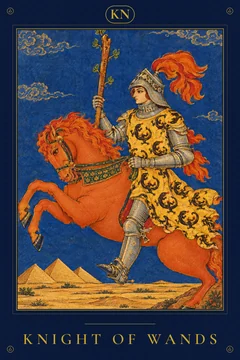
A rider on a rearing orange horse, reversed. The urge to settle everything at once, resigning from the firm in a week or ordering a new machine before the old orders are counted, will break off halfway if he follows it. The card's counsel is to rein in without dismounting and to finish one stage before announcing the next.
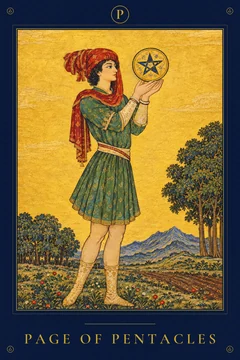
A youth in a flowering field holds one coin up to the light and studies it. An accountant learning a trade from the floor upward is this Page exactly, the Earth of Earth, patient and literal. His stance is sound: study the business before spending anything on it.
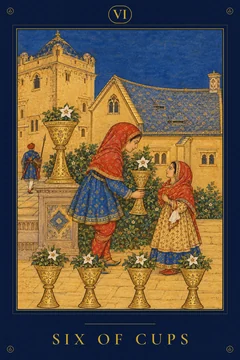
In the courtyard of an old manor a boy hands a small girl a cup of white flowers. His mother and the two old compositors want the press kept as it was in his childhood, and their affection is real. Honour it, and keep it from setting the price list.
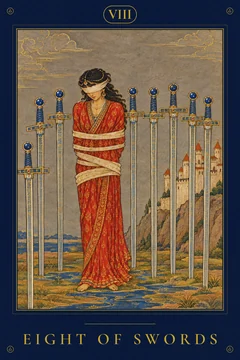
A bound and blindfolded woman stands among eight swords, reversed, so the blindfold is slipping and the gaps between the blades show. He hopes the trap was never real and that he could walk out of either life. He fears exactly the same thing, because then no excuse remains for not choosing.
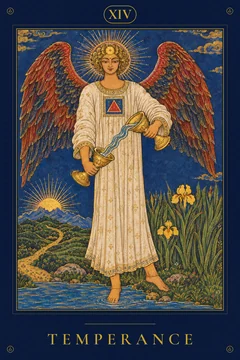
At the top an angel pours water from one cup into the other, one foot on the bank and one in the pool. The outcome is a blend: his practice kept on reduced hours while the press is reorganised, the two lives mixed by measure until the mixture holds. Temperance asks for patience and gives a result that lasts because nothing was forced.
Synthesis
Begin with the count. Each of the four suits appears exactly twice among the minors, and that evenness is a message in itself: no one part of his life should swallow the others. Fire is the strongest element, carried by the Ten and the Knight of Wands, by the Emperor's Aries and by Temperance, which the Golden Dawn gives to Sagittarius. The same tradition places the Ten of Wands under Saturn in Sagittarius, so the burden at the heart and the angel at the top share one sign. It is one fire, first as a load and at last as a measured pour. Now set the crossing card beside the outcome. The Two of Swords keeps a balance by refusing to look. Temperance makes a balance by moving water between two cups, again and again, watching it. The reading moves him from the first kind to the second. The reversals fall at the root, the near future and the hopes, the places where he defers to his father or else wants to rush. The plain answer is that he can take on the press, provided he does not stack it on his firm as a second full load and does not hurry. His next step is to sit with his father this month and put the press's real accounts on the table, every client and every rupee owed, so the decision rests on figures he has read himself.
Before you lay it
Common mistakes
Reading ten cards as ten separate answers. Read the cross first as one picture, then the staff, and then ask how card 10 grows out of cards 1 and 2.
Treating the crown and the outcome as the same position. The crown is what may be, the best available or the conscious aim, and the outcome is where things are heading; read the gap between them as the work to be done.
Laying the spread again because the outcome disappoints. A second Celtic Cross on the same question the same day only muddies the first, so go back to the crossing card and act on what it asks.
Reading the hopes-and-fears card in one direction only. Ask what the querent would hope if it came true and what they would fear, since the two are usually the same event.
Why do some books number the Celtic Cross positions differently?
Waite's book places the crown third and the foundation fourth, followed by what lies behind and what lies before. TarotPandit numbers them foundation, recent past, crown, near future, as listed above. The positions and their meanings are the same either way, so choose one numbering and keep to it.
Do I need a significator card for the Celtic Cross?
Waite's method begins by choosing a significator, a card set out to stand for the querent before the ten are laid. It is optional. The TarotPandit reading draws the ten positions without one, and card 7 describes the querent's stance in the matter.
Is the Celtic Cross a good spread for beginners?
It is the spread most students want to learn first and the one they should learn third. Work with daily cards and the past, present, future spread until joining cards feels natural, and the ten positions turn out to be a set of short sentences you already know how to read.
How does the Celtic Cross spread work?
You ask your question, shuffle, and choose 10 cards. Each card is read in its position, then the reading closes with a synthesis that joins them.
Is the reading free?
Today's card, yes or no, past-present-future and the Celtic Cross are free, three readings a day without an account. The other spreads are part of Premium.
What does a reversed card mean?
A reversed card is the same energy turned inward, delayed or asked for differently. TarotPandit never reads it as a closed door: every reversal names a step.
Are the readings in Hindi?
Every reading comes in English and Hindi. Use the language button to choose which leads.