TarotPanditby Pandit Rahul Kaushl
Readings · Premium

Decision निर्णय

Two roads laid side by side, three cards each: how each choice feels now, how it unfolds, and where it ends.

दो मार्ग साथ-साथ, हर एक के तीन कार्ड: हर विकल्प अभी कैसा लगता है, आगे कैसे खुलता है, और कहाँ पूरा होता है।

Premium spread

Two roads laid side by side.

The Decision spread is part of Premium. Premium opens every spread, unlimited, with the five areas of life on every card and a sealed PDF of each reading.

₹299 a month, or ₹1,999 a year (save 44%), less than ₹6 a day
Positions · स्थान
  1. Path A: now मार्ग क: अभी
  2. Path A: later मार्ग क: आगे
  3. Path A: outcome मार्ग क: परिणाम
  4. Path B: now मार्ग ख: अभी
  5. Path B: later मार्ग ख: आगे
  6. Path B: outcome मार्ग ख: परिणाम
How it is read

Each card is read in its position from the TarotPandit library: the card speaks, the position, the cards together, and practical guidance, in English and Hindi, closing with a synthesis.

The guide

When to use this spread

Use this spread when you have two real options and keep swinging between them, such as two job offers, or a move against staying where you are. It works best when each path can be named in one sentence before you shuffle. If there is only one option and the question is whether to take it, the yes-or-no card answers faster. If there are three or more paths, narrow them first: the spread compares two columns, and a third blurs both. When the choice sits inside a larger tangle, lay the Celtic Cross to see the whole situation, and return here once the two roads are clear.

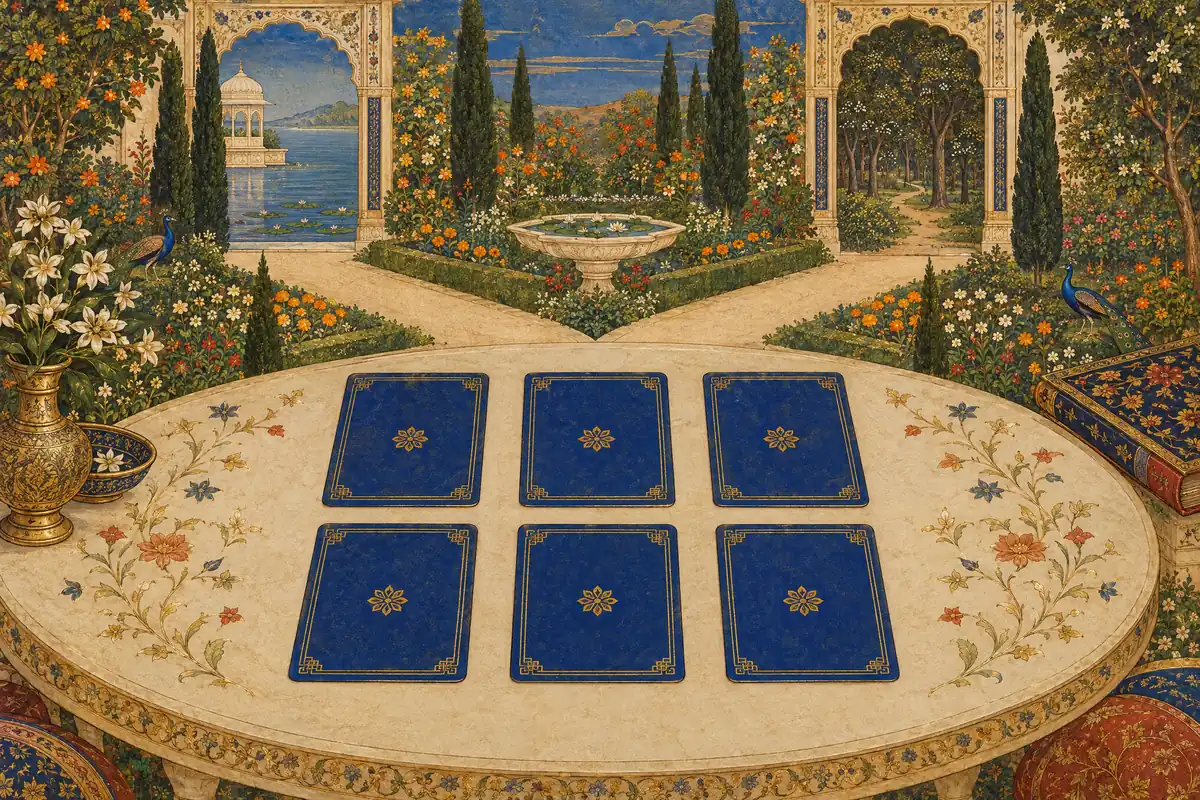
How to lay the Decision spread: 6 cardsBefore you shuffle, write down which option is Path A and which is Path B, and do not swap them afterwards. Lay the first three cards in a column on your left for Path A: now nearest you, later above it, outcome furthest away. Lay the next three in a column on your right for Path B, in the same order. You now have a grid of three rows, the two nows side by side, then the two laters, then the two outcomes. Read down each column, then across each row.123456Path APath BYOU SIT HERE
The numbers match the positions listed alongside
By hand

How to lay it out

Before you shuffle, write down which option is Path A and which is Path B, and do not swap them afterwards. Lay the first three cards in a column on your left for Path A: now nearest you, later above it, outcome furthest away. Lay the next three in a column on your right for Path B, in the same order. You now have a grid of three rows, the two nows side by side, then the two laters, then the two outcomes. Read down each column, then across each row.

What each position asks

  1. Path A: now मार्ग क: अभी

    How the first path feels and stands at the moment of choosing, including whatever pull or fear it carries today. It sits nearest you because it is closest to what you already know. Compare it straight across with Path B: now before reading anything else.

  2. Path A: later मार्ग क: आगे

    What the first path asks of you once the novelty passes, roughly the middle months. Most choices are won or lost in this stretch, so give it as much weight as the outcome. A demanding card here names a cost to plan for, and costs can be met.

  3. Path A: outcome मार्ग क: परिणाम

    Where the first path settles if you walk it honestly. It sits at the far end of the column because it is furthest away in time. Read it together with the card below it: an outcome that grows out of a hard middle card has been earned.

  4. Path B: now मार्ग ख: अभी

    The same question asked of the second path. If one option is to stay where you are, this card shows how staying feels when you look at it squarely. Set it beside Path A: now and notice which way each card faces.

  5. Path B: later मार्ग ख: आगे

    The middle stretch of the second path. Put it beside Path A: later and ask which difficulty you would rather carry, since every road has one. A quiet card here can hide a slow cost.

  6. Path B: outcome मार्ग ख: परिणाम

    Where the second path settles. Compare the two outcomes last, after you have seen how each column moves. A pleasant outcome reached through a draining middle may cost more than it looks.

One reading, start to finish

A worked example

A 41-year-old schoolteacher in Lucknow, fourteen years at a government-aided school, offered the post of vice-principal at a new private school in Noida.

"Should I take the vice-principal post in Noida or stay at my school in Lucknow?"
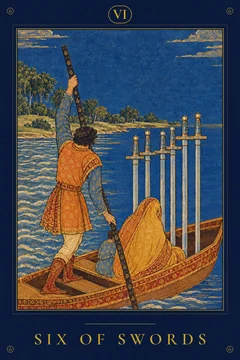
1 · Path A: now

Six of Swords तलवारों का छहReversed

Path A is taking the post. A ferryman poles a narrow boat toward a wooded shore, a hooded woman and a child seated among six upright swords. Reversed, the crossing waits at the jetty. Waite reads the reversal as declaration, something carried in silence that must now be spoken aloud, and modern readers add a departure held up by unfinished business. Both fit her. Before she steps into the boat she has to tell her principal and her colleagues of fourteen years, and that conversation, more than the move itself, is what makes the post feel heavy today.
2 · Path A: later

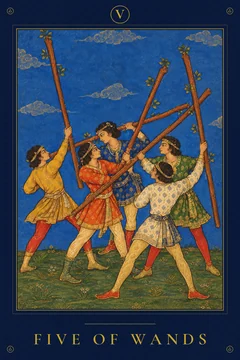
Five of Wands दंडों का पाँच

Five young men in tunics of five colours swing their staves in a skirmish nobody has won yet. In the middle months of the new post this is a staff room of strong opinions in a young school still deciding how things are done, with a vice-principal expected to hold the field. Waite allows the card a sham fight as well as real competition, and upright it is the useful kind of friction. She will be tested, and the test will make her better at the work.

3 · Path A: outcome

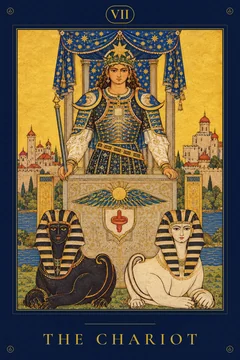
The Chariot रथ

A crowned driver stands in a stone chariot with no reins in his hands, a black sphinx and a white one at rest before him. Card VII is victory through direction, opposed forces held under a single will. After the skirmish of the Five, this is the vice-principal whose quarrelling staff now pull the same way. It is the only Major Arcana card in either column, and it lands at the end of Path A, which gives this road a weight the other lacks.

4 · Path B: now

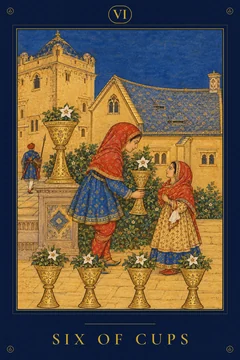
Six of Cups प्यालों का छह

Path B is staying. In an old courtyard a boy offers a smaller girl a cup filled with white flowers. Staying feels warm and familiar, full of fourteen years of goodwill, of colleagues who were once her teachers and former pupils who now bring their own children to the gate. Waite reads the card as memories and a happiness that comes from the past. That warmth is real and deserves honour. Notice, though, which way the card looks: its gifts come from what was.

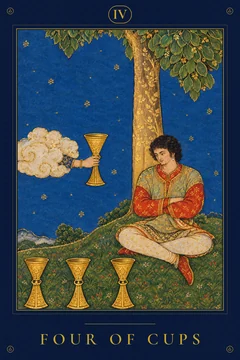
5 · Path B: later

Four of Cups प्यालों का चार

A young man sits under a tree with folded arms, staring at three cups on the grass, while a hand from a cloud holds out a fourth he does not see. In the middle stretch of staying, the comfort goes flat. The lessons repeat, and a restlessness sets in that she cannot name. The card's real warning is the overlooked offer, and in this reading the offer is plain to see: the Noida post, held out from the cloud while she looks at the cups she already has.

6 · Path B: outcome

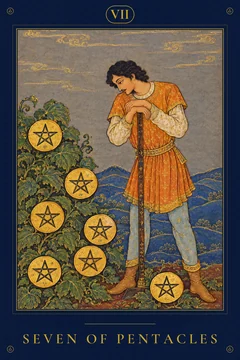
Seven of Pentacles मुद्राओं का सातReversed

A young man leans on his hoe and looks at the coins growing on his vine. Upright he is patient. Reversed, the Golden Dawn's Lord of Success Unfulfilled becomes impatience: effort that feels unrewarded, or work kept up after it has stopped growing. At the end of this road stands a good teacher still tending a vine that has given what it can. A reversal names a delay and asks for a correction. If she stays, she will need a new field inside the old school, a department to lead or a programme of her own to build.

Synthesis

Read the rows first. Both paths open on a Six, Swords against Cups, and both Sixes show someone being helped, a ferryman carrying his passengers and a boy handing over a cup. What separates them is the direction each card faces. The boat is bound for a new shore, while the courtyard looks back into memory. In the middle row the noisy competition of the Five of Wands sits beside the flat contentment of the Four of Cups. Quiet difficulty tends to outlast loud difficulty, because nothing forces anyone to deal with it. The outcome row sets the Chariot against a reversed Seven of Pentacles. Now read the columns. Path A climbs from Air to Fire to a Major Arcana card, and the Chariot belongs to Cancer, so the Water that fills Path B waits at the top of Path A too, steered this time. Path B stays in Water for two cards and settles into reversed Earth. Each column carries one reversal, at opposite ends. The difficulty of Path A comes first, at the jetty, and can be dealt with in a fortnight; the difficulty of Path B comes last, after years at the vine. Even the Four of Cups points across the table, since the cup it ignores is the offer itself. The plain answer leans toward Noida, with the farewell and the Five of Wands as the costs to plan for. Before she accepts, she should spend one working day at the new school, meet the staff she would lead, and ask for the vice-principal's duties in writing.
Before you lay it

Common mistakes

  • Reading the six cards as one long story from first to last. Read down each column and then across each row, and let the comparison carry the decision.
  • Deciding which path is A and which is B after the cards are turned. Write both options down before you shuffle and keep them fixed.
  • Judging a path by its outcome card alone. Give the later card equal weight, because that is the stretch you will live in longest.
  • Laying the spread for a choice between three or more options. Narrow the field to two first, or lay a separate spread for each pair you need to compare.
Premium
The Decision spread and every other spread, unlimited
See Premium
FAQ

Questions people ask

What if both paths look good in a decision tarot spread?

Then the choice is freer than you feared, and either road can work. Look at the later row and choose the difficulty you would rather carry. If they still tie, take the path you can begin sooner.

Can I use the decision spread for a yes or no question?

Yes. Make Path A doing the thing and Path B leaving it undone. This often works better than a single card, because it shows the cost of saying no as clearly as the cost of saying yes.

How does the Decision spread work?

You ask your question, shuffle, and choose 6 cards. Each card is read in its position, then the reading closes with a synthesis that joins them.

Is the reading free?

Today's card, yes or no, past-present-future and the Celtic Cross are free, three readings a day without an account. The other spreads are part of Premium.

What does a reversed card mean?

A reversed card is the same energy turned inward, delayed or asked for differently. TarotPandit never reads it as a closed door: every reversal names a step.

Are the readings in Hindi?

Every reading comes in English and Hindi. Use the language button to choose which leads.