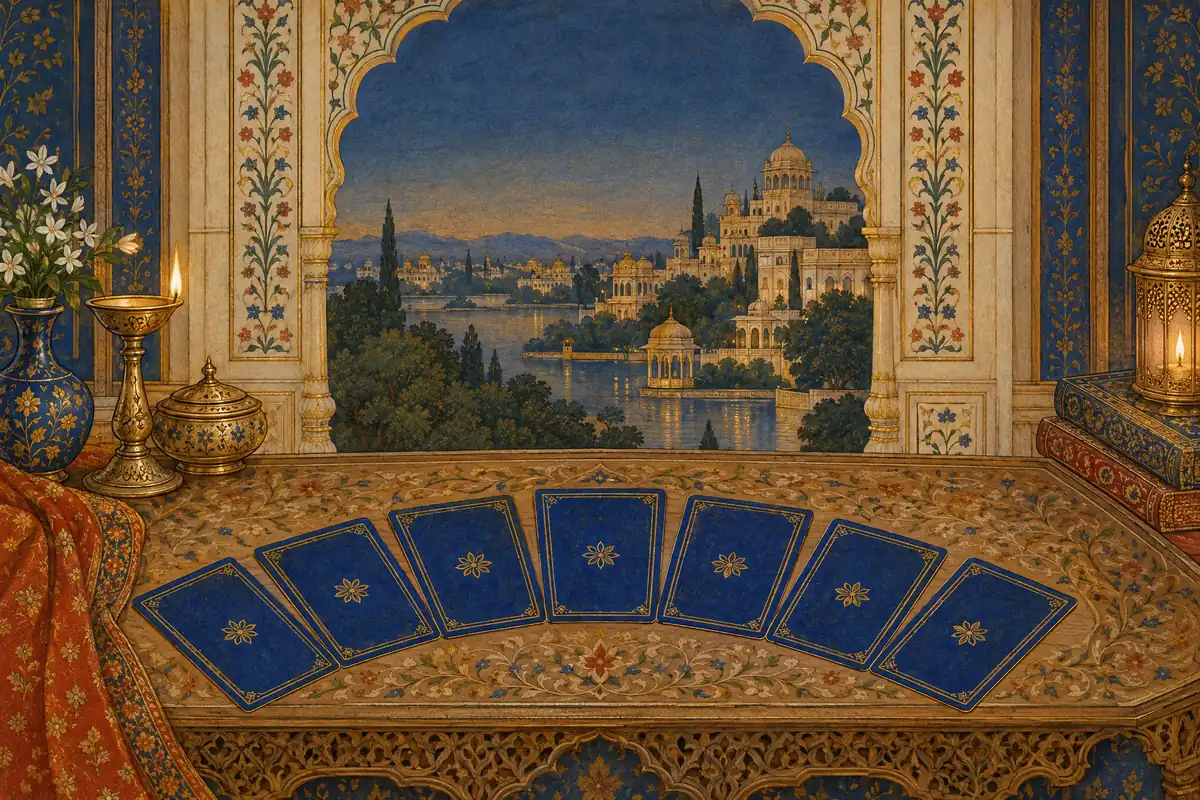
Seven cards in an arc: the past, the present, the hidden influence, the obstacle, those around you, the advice and the outcome.
चाप में सात कार्ड: अतीत, वर्तमान, छिपा प्रभाव, बाधा, आपके आसपास के लोग, परामर्श और परिणाम।
The past
The present
The hidden influence
The obstacle
The environment
The advice
The outcome
Premium spread
Seven cards in an arc.
The Horseshoe spread is part of Premium. Premium opens every spread, unlimited, with the five areas of life on every card and a sealed PDF of each reading.
₹299 a month, or ₹1,999 a year (save 44%), less than ₹6 a day
Each card is read in its position from the TarotPandit library: the card speaks, the position, the cards together, and practical guidance, in English and Hindi, closing with a synthesis.
The guide
When to use this spread
The horseshoe suits a situation with some history behind it and more than one person involved, where you want to see how things reached this point and what to do next. It answers general questions well, such as a family matter or a change of role. Its particular strength lies in two positions most short spreads lack: the hidden influence, and the environment of people around you. For a quick look at a single question, the three-card past-present-future is lighter. For a matter with real depth, or one that has troubled you for months, the Celtic Cross gives ten positions to the horseshoe's seven.
The numbers match the positions listed alongside
By hand
How to lay it out
Lay seven cards in a U with the open end away from you. Begin at your upper left with the past and come down the left arm: the present, then the hidden influence. The obstacle sits alone at the bottom of the curve, the lowest point of the shape. Climb the right arm with the environment, then the advice, and finish with the outcome at upper right. The past and the outcome now face each other across the open end, and the obstacle lies nearest you, within reach of your hand.
What each position asks
1
The past अतीत
What has shaped the situation and still colours it. It sits at the top of the left arm, facing the outcome across the gap, because the two are read as a pair: what the matter was, and what it can become. Look for the habit the querent brings into the question from before.
2
The present वर्तमान
The situation as it stands today, and the querent's own part in it. It sits just below the past because it grows out of it. Read it as a description and keep your judgement for the advice card.
3
The hidden influence छिपा प्रभाव
Something at work that the querent does not see, or would prefer not to: a motive, or a fear kept out of view. It sits low on the left arm, beside the obstacle, because what is hidden often feeds what blocks. Read it gently, since this is the card people most often argue with.
4
The obstacle बाधा
The thing in the way, at the bottom of the curve. It sits alone and nearest the reader because it is the card you can actually handle, and the whole shape turns on it. A reversed obstacle often shows a block that is already half loosened.
5
The environment परिवेश
The people and conditions around the querent: family, colleagues, customers, the place itself. It begins the climb up the right arm because the way past an obstacle usually runs through other people. Ask whether this card supports the querent or presses on them.
6
The advice परामर्श
What the cards suggest the querent do, as one clear action if possible. It sits just below the outcome because it is the lever that moves it. If the advice runs against the querent's wishes, take it seriously, because it often names what they already suspect.
7
The outcome परिणाम
Where the matter is heading if the advice is taken. It completes the arc opposite the past. Read the two together, because the distance between them is the change the whole spread describes.
One reading, start to finish
A worked example
A 58-year-old owner of a sweet shop in Amritsar's old city, a business his grandfather opened, who is thinking of handing it to his son.
"What do I need to see before I hand the shop over to my son?"
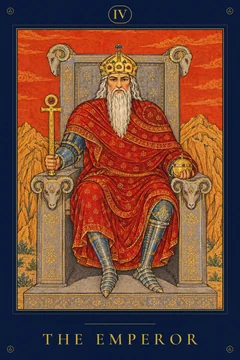
A bearded king sits squarely on a stone throne carved with rams' heads, an ankh sceptre in his right hand and an orb in his left, bare mountains behind. This is how the shop has been run for thirty years: one man at the counter and the books kept in his own hand. Waite gives stability and protection among the card's meanings, and the shop owes its survival to both. The Emperor is the foundation of this reading. He is also the habit that will have to change.
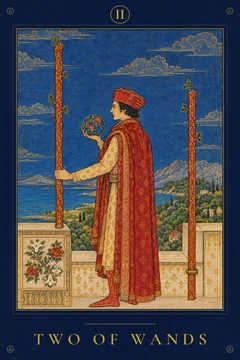
A man on a battlement holds a small globe and looks out to sea, one wand in his grip and a second fixed to the wall by a ring. Reversed, the plan stays in his head, the globe turned over and over and never set down on a road. The handover has come up at family dinners for two years and has never been given a date. Waite's reversed meanings include surprise and enchantment, a man taken with the idea of change who has not yet acted on it. Notice the fixed wand. Part of him wants to stay clamped to the wall.
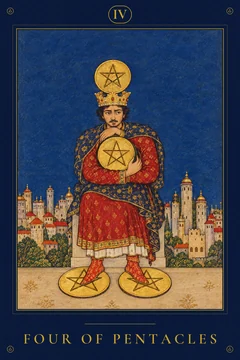
A crowned man sits clutching one coin to his chest, with another balanced on his crown and one pinned under each foot. He cannot stand up or walk anywhere without letting a coin go. This is the influence he does not see, though his son very likely does: his hold on the cash box and the recipes. Waite adds legacy and inheritance to the card's meanings, so the grip and the gift appear in one picture. The question for him is which coin he truly needs to keep holding.
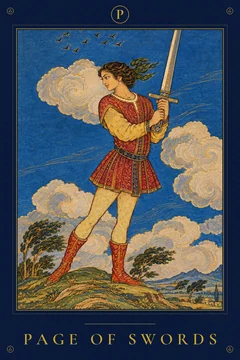
A youth on a windy hill holds a sword upright and glances back over his shoulder. Reversed, the quick mind turns to rumour and to talk without preparation. The obstacle is the way the handover is being discussed, through the staff and the cousins and seldom face to face. The son hears his father's doubts second-hand and answers them the same way. The card's remedy is simple: check the facts, prepare before speaking, and then say it directly to the person concerned.
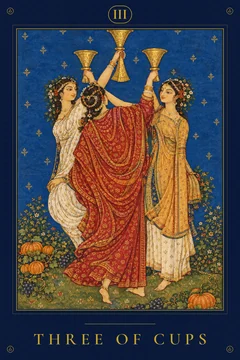
Three women dance in a garden with their cups raised high, pumpkins and grapes at their feet. The people around this shop are glad of it. The long-serving cooks and the regular customers want it to continue, and the wider family would be happy to celebrate it. Waite reads the card as a matter brought to its conclusion in plenty. The environment is a support, and a good handover could be marked openly, in front of the people who keep the shop alive.
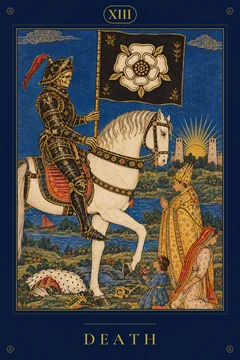
A skeleton in black armour rides a white horse under a black banner bearing a white rose, while a king lies fallen and the sun rises between two towers. In this position Death names an ending, and the ending is a role, never a person. Waite reads the card as change and passage from one state to another. The fallen king is the detail to sit with: a crown on the grass. The advice is to let the old way of running the shop finish deliberately, with a date and some ceremony, and to honour it as it goes.
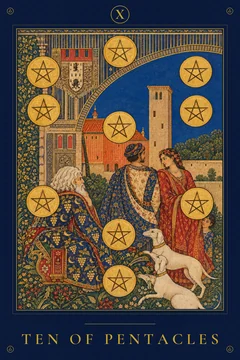
A white-bearded elder sits at the gate with two white dogs, while a couple talk beneath the archway and a child peeps from behind the woman's robe. Ten coins hang over the scene in the pattern of the Tree of Life. This is wealth that has become a family: the shop held across generations, its elder still present and honoured, though no longer at the counter. Waite reads the abode of a family and its archives. The old man's eyes are on his people, and the coins hang above him unregarded.
Synthesis
Start with the pair at the open ends. The Emperor in the past faces the Ten of Pentacles in the outcome, and one man on a throne becomes a whole household under an arch. That distance is the change this reading describes. Then the numbers. The Emperor is card IV and the Four of Pentacles sits in the hidden place, so the same square structure appears twice, once as strength and once as grip. The Golden Dawn gives the Emperor to Aries and the Two of Wands to Mars in Aries, which means the past and the present share one temperament: the founder's fire that built the shop and now hesitates to let it go. Both reversals fall on the way down the arc, at the present and the obstacle: the plan kept in his head and the talk that goes round corners. Each of them is a problem of speech. Water arrives at the turn of the arc in the Three of Cups and in Death, a Scorpio card, and Earth waits at the end. Read elementally, the fire of the founder passes through feeling and comes out as a lasting estate. The plain answer is that the shop can pass well and the work lies with him. He should fix a date for the handover, tell his son first and in person, and then announce it to the staff with his son beside him.
Before you lay it
Common mistakes
Reading Death in the advice position as a warning about someone's life. Read it as the end of a role or a chapter, which is what Waite meant by change and passage.
Reading the seven cards in a straight line and forgetting the shape. Pair the past with the outcome across the open end, and treat the obstacle at the base as the card the arc turns on.
Hurrying past the hidden influence because it is uncomfortable. Ask who else in the querent's life might recognise the card, and treat it as information that was missing.
Treating the environment card as a verdict on other people. Read it as the conditions around the querent, and ask how to work with them.
Premium
The Horseshoe spread and every other spread, unlimited
Is the horseshoe tarot spread good for yes or no questions?
Not especially. It is built to show how a situation developed and where it is going, which needs a question with some room in it. For a straight yes or no, use the yes-or-no reading and keep the horseshoe for the why.
Which way should the horseshoe open?
At TarotPandit we open it away from the reader, so that the obstacle at the bend lies closest to your hands. Some readers lay it the other way up. Choose one shape and keep it, so that each position stays fixed in your eye.
How does the Horseshoe spread work?
You ask your question, shuffle, and choose 7 cards. Each card is read in its position, then the reading closes with a synthesis that joins them.
Is the reading free?
Today's card, yes or no, past-present-future and the Celtic Cross are free, three readings a day without an account. The other spreads are part of Premium.
What does a reversed card mean?
A reversed card is the same energy turned inward, delayed or asked for differently. TarotPandit never reads it as a closed door: every reversal names a step.
Are the readings in Hindi?
Every reading comes in English and Hindi. Use the language button to choose which leads.