The ledger read as a path: the present state, what helps, what hinders, the next sensible move and the outcome. Attention and action, never investment advice.
बही-खाते को एक मार्ग की तरह पढ़ना: वर्तमान स्थिति, जो सहायक है, जो बाधक है, अगला समझदार कदम और परिणाम। ध्यान और कर्म, निवेश-सलाह कभी नहीं।
The current state
What helps
What hinders
The next move
The outcome
Premium spread
The ledger read as a path.
The Money and business spread is part of Premium. Premium opens every spread, unlimited, with the five areas of life on every card and a sealed PDF of each reading.
₹299 a month, or ₹1,999 a year (save 44%), less than ₹6 a day
Each card is read in its position from the TarotPandit library: the card speaks, the position, the cards together, and practical guidance, in English and Hindi, closing with a synthesis.
The guide
When to use this spread
Lay this spread when money keeps moving in a way you cannot explain: income that arrives and is gone within the week, or a business whose takings look healthy while the bank balance does not. The cards look at your habits and at where your attention goes, and they end on something you can do with your own hands this month. They will not name a share to buy or a date when prices turn; a reader who promises that has stopped reading tarot. If the question is really about your work or your role, the career spread asks it better. If you are choosing between two offers, use the decision spread first and come back here once you have chosen.
The numbers match the positions listed alongside
By hand
How to lay it out
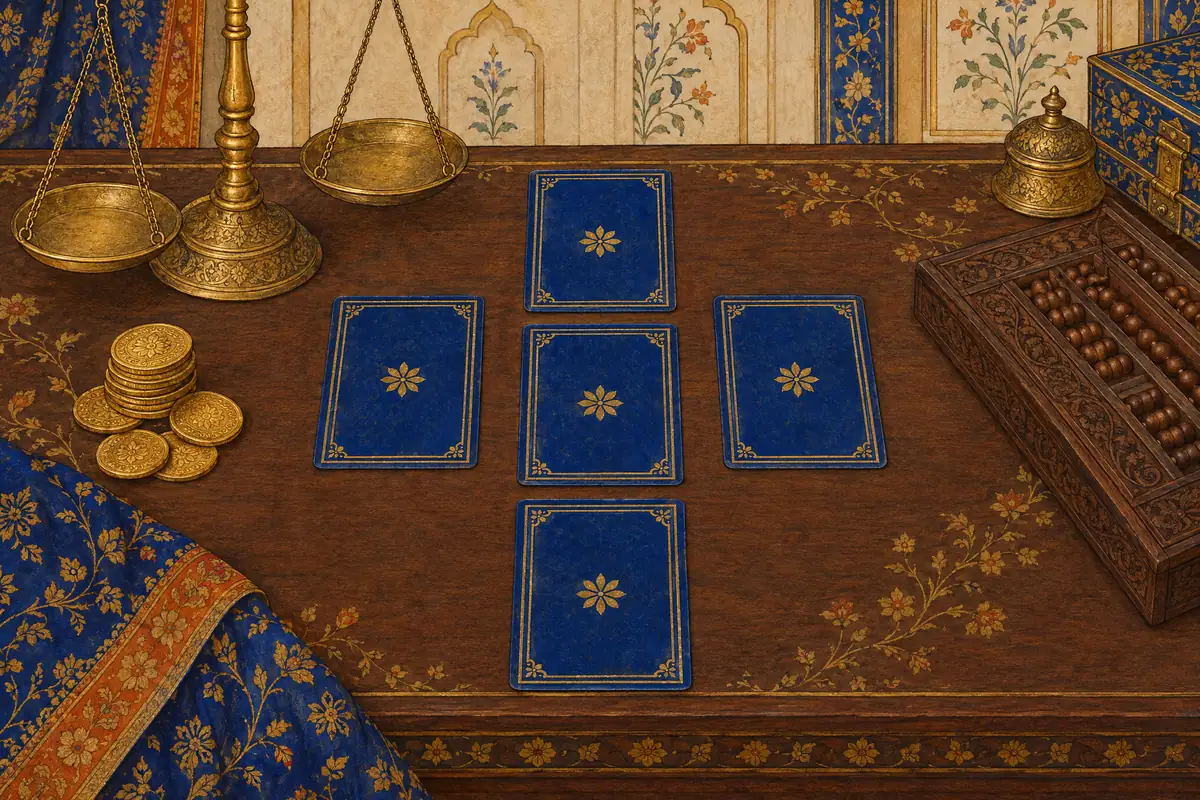
Shuffle with the question in mind and lay five cards face down. The first, the current state, goes in the centre. What helps sits to its left and what hinders to its right, like the two columns of a ledger. The next move goes below the centre card, nearest you, because it is the ground your feet touch first. The outcome goes above, furthest away. Turn the cards in the order you laid them. Read the middle row as the account, then read the column from bottom to top as the plan.
What each position asks
1
The current state वर्तमान स्थिति
This is the account as it stands today, before any judgement about it. It sits at the centre because the helping and hindering cards only make sense against it, the way an entry means little until you know the opening balance. Look at the suit first: Pentacles speak of the money itself, Cups of the feelings driving it, Swords of worry or an unmade decision, Wands of effort and appetite.
2
What helps जो सहायक है
The resource already in your hands, and often one you undervalue: a skill, say, or a client who keeps coming back. It sits on the left, the side of what comes in. A reversed card here still helps, but the help is underused or arriving late, so ask what would bring it forward.
3
What hinders जो बाधक है
The leak. It sits on the right, the side of what goes out, and it is usually a habit, which is good news, because habits can be changed. Read it without blame: the card names where the money slips so that you can put a hand over the gap.
4
The next move अगला कदम
The one practical action the cards ask for, sized for this week or this month. It sits nearest you because it is the only position you control completely. If the card looks grand, find the humblest version of its advice and do that first.
5
The outcome परिणाम
Where the account is heading if the next move is made and kept for a season, usually three to six months. It sits furthest from you because it is the least fixed of the five. Read a reversed outcome as the same result arriving more slowly or asking for one more correction, and look back at the next move to find it.
One reading, start to finish
A worked example
A 29-year-old freelance illustrator in Jaipur whose income arrives in uneven lumps from four regular clients.
"Why does my money never stay with me, and what should I change this year?"
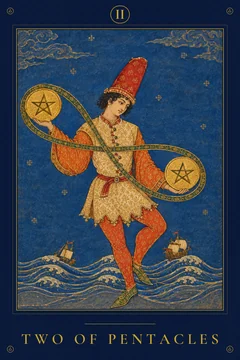
Upright, the young man in the tall red hat dances easily with his two coins on their green ribbon. Turned over, the dance has become a scramble while the ships behind him ride a higher sea. This is cash flow that has outrun the person managing it, and for a freelancer it is exact: payments land on one set of dates, bills on another, and she has kept a cheerful face while the two coins drifted apart. What the card points at is the count, and nobody is keeping it.
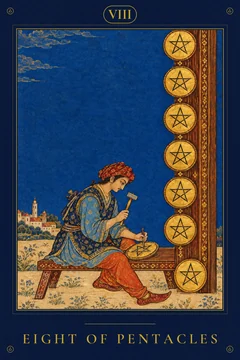
Her strongest asset is the craftsman on his bench, chisel set on the eighth disc, six finished pieces hanging on the post beside him. Her skill is real and still growing, and clients return for it. The card's money meaning is plain: income that follows craft and steady hours. It also hints at a quiet fix. The craftsman counts by pieces finished, and she can do the same, learning what each commission actually earns once the rounds of revisions are counted in.
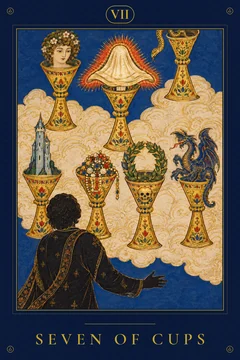
The leak is the cloud of seven cups, jewels heaped in one and a castle on a rock in another, with the dark figure reaching toward all of them at once. It is the only Water card in the spread, and it brings feeling into a practical matter. Her spare money goes to possibilities: a new tablet bought for work that has not yet come, a course paid for and never opened. The card carries its own remedy. Test each wish against facts and let only one cup come down to the ground.
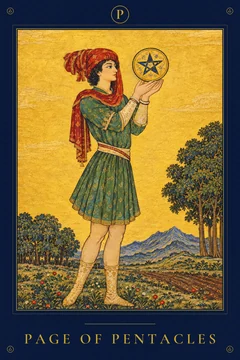
The student in the flowering field holds a single coin up in both hands and studies it. The move is as ordinary as the card: one notebook, every rupee in and out written down for thirty days, with no judging of any entry while the month runs. The Page does not cut spending yet. He looks first. By the end of the month she will know her true monthly cost, the figure she has so far been guessing.
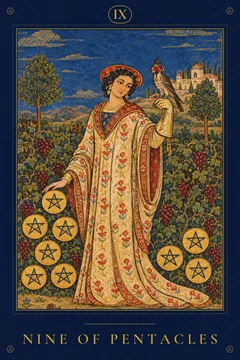
A woman stands at ease in her own vineyard with a hooded falcon on her glove and a manor on the hill behind. This is self-sufficiency earned by discernment, and the hood on the falcon is the detail to teach from: appetite kept under control, serving her instead of steering her. Six coins stand among the vines at her right hand and three further off, money in use and money held back. If the notebook month is kept and its lesson becomes a habit, she is standing in a garden she can afford within the year.
Synthesis
Four of the five cards are Pentacles, so this is truly a money question and the answer will be practical. No Major Arcana appears, which fits: the matter sits in daily habit and in her hands, with no great turn of fate involved. The single exception to the Earth is the Seven of Cups in the hindering place, and that tells you where the trouble lives. It is in wishing, outside the ledger. Her craft, the Eight, is sound, and the Nine shows where it can take her. Follow the numbers of the suit and the spread tells the suit's own story, from the juggling Two to the walled garden of the Nine, with the Page at the bottom as the student who makes the climb possible. The only reversal sits in the present, the easiest position to change. So the plain answer is this: her money does not stay because no one watches it between arrival and departure, and what is spare drifts up into the cups on the cloud. She needs a count before she needs a cut. The next step is the Page's notebook, thirty days of every rupee written down, followed by one rule chosen from what it shows, such as moving a fixed sum into a separate savings account on the day a client pays.
Before you lay it
Common mistakes
Reading the outcome card as a promise of a sum or a date. Read it as the direction the account takes if the next move is kept, and judge it again after three months.
Asking the spread whether to buy shares or gold. Ask it about your own habits and attention, and take investment questions to a registered adviser.
Hurrying past the hindering card because it stings. Give it the longest look of the five, since the leak it names is usually where the quickest gain lies.
Turning the next move into a grand plan. Find the smallest version of the card's advice, one you can finish this week, and do only that.
Premium
The Money and business spread and every other spread, unlimited
Can a tarot money reading tell me if I will become rich?
No honest reader promises that. The money spread shows the pattern behind your finances and the next sensible action, and it does that well. Where wealth comes, it is built by the kind of small actions the cards point to, kept up over months.
How often should I lay the money spread?
Once for a question, and not again until you have acted on the next move, usually a month later. Laying it every few days tends to produce a heap of half-answers. Keep a note of each reading so that you can compare the outcome card with what actually happened.
What does it mean if no Pentacles appear in a money reading?
Then the money question is being driven by something other than money. A run of Cups usually points to comfort spending. Swords bring worry into the account, or a decision someone keeps putting off, and Wands tend to mean that ambition or overwork is setting the pace. Read the suit that dominates as the true subject of the reading.
How does the Money and business spread work?
You ask your question, shuffle, and choose 5 cards. Each card is read in its position, then the reading closes with a synthesis that joins them.
Is the reading free?
Today's card, yes or no, past-present-future and the Celtic Cross are free, three readings a day without an account. The other spreads are part of Premium.
What does a reversed card mean?
A reversed card is the same energy turned inward, delayed or asked for differently. TarotPandit never reads it as a closed door: every reversal names a step.
Are the readings in Hindi?
Every reading comes in English and Hindi. Use the language button to choose which leads.