For the dark of the moon, the time of beginnings: the intention, what to release, what supports you, the obstacle and the outcome.
अमावस्या के लिए, आरंभ का समय: संकल्प, क्या छोड़ें, क्या सहारा देता है, बाधा और परिणाम।
The intention
What to release
What supports
The obstacle
The outcome
Premium spread
For the dark of the moon.
The New moon spread is part of Premium. Premium opens every spread, unlimited, with the five areas of life on every card and a sealed PDF of each reading.
₹299 a month, or ₹1,999 a year (save 44%), less than ₹6 a day
Each card is read in its position from the TarotPandit library: the card speaks, the position, the cards together, and practical guidance, in English and Hindi, closing with a synthesis.
The guide
When to use this spread
The new moon is the night the moon shows no light, the start of a cycle of about twenty-nine and a half days. From here the light grows each evening until the full moon some two weeks later, which makes this the natural moment to name what you want to grow. Lay the spread on the new moon or in the day or two after, when the first thin crescent appears at dusk. Indian readers know this night as Amavasya, after which the bright fortnight, shukla paksha, begins. The spread borrows that rhythm as a cultural parallel and makes no ritual claim. Come back to the same question with the full moon spread about a fortnight later. For a single choice between options, the decision spread is better.
The numbers match the positions listed alongside
By hand
How to lay it out
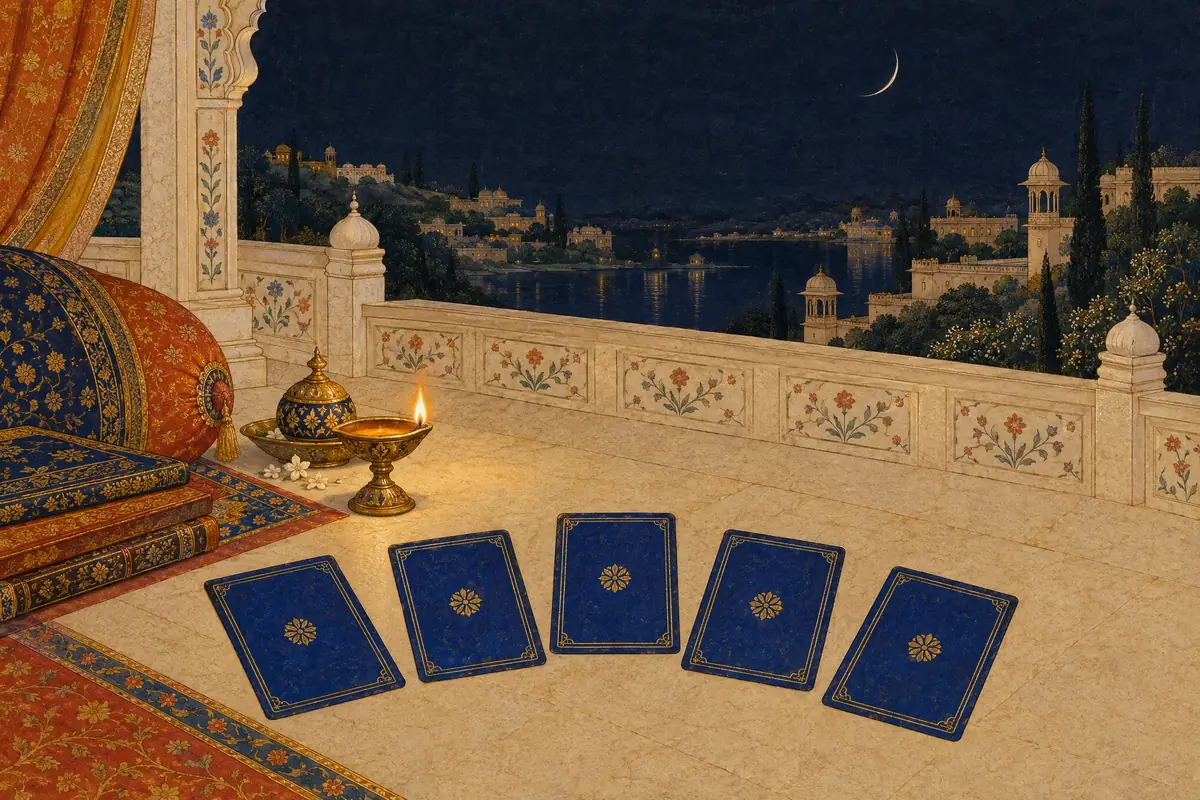
Lay the intention in the centre. Put what to release on its left, the side of what lies behind you, and what supports directly beneath it, as the ground it stands on. The obstacle goes above the intention, where it hangs over the plan, and the outcome on the right, the side of what is coming. You now have a small cross with the intention at its heart. Turn the cards in that order, release before support, because a gardener clears the ground before planting.
What each position asks
1
The intention संकल्प
The seed for this lunar month: one aim, small enough to tend for four weeks. Read the card as the shape the intention wants to take, which may differ from the one you walked in with. Aces and the low numbers sit naturally here, while a Ten suggests the intention is to finish something already begun.
2
What to release क्या छोड़ें
What has to be cleared before the seed can take, usually a habit or a grip on something that has served its time. It sits on the left because it belongs to what is behind you. A reversed card here often shows something already loosening, which needs only your consent to go.
3
What supports जो सहारा दे
The ground under the intention: a skill you already hold, or a person who helps. Read it generously. Readers in a hurry to reach the obstacle often skim this card and miss the very resource the obstacle calls for.
4
The obstacle बाधा
What hangs over the plan and could stall it. Read it with the supporting card two places below, since the spread nearly always holds the answer to its own obstacle. When the obstacle shares a suit with the intention, the danger lies in the intention's own excess.
5
The outcome परिणाम
Where the intention is heading by the end of the cycle, if you tend it as the cards advise. Read it as a likely direction that your own actions can still change. A hard card here is a reason to adjust the intention now, while it is still a seed.
One reading, start to finish
A worked example
A 31-year-old graphic designer in Pune who has not drawn anything for herself in two years and wants to start again.
"What intention should I set this new moon for my own drawing, and what will help it take root?"
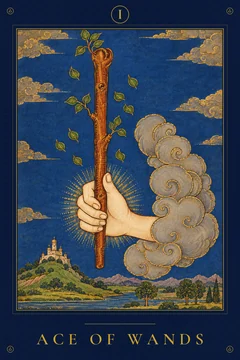
A hand reaches out of a grey cloud and grips a living wand, green shoots along its length and eight leaves falling away, a castle on the hill below. The intention could hardly be plainer: begin. Waite reads creation and invention, the starting point of enterprises. The card wants the wand gripped within days, so the intention should be concrete and small, one drawing a morning in a sketchbook, for herself, until the next new moon.
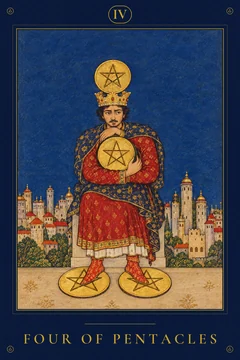
A crowned man sits facing us with one pentacle clutched to his chest, one balanced on his crown and two pinned under his feet, a city behind him. This is the grip she has to loosen: keeping every drawing hidden until it is good enough, the way she guards client work before it is signed off. Waite reads cleaving to what one has. The man cannot stand or travel without letting go of a coin, so she should let the sketchbook be untidy and show one page to a friend before the month is out.
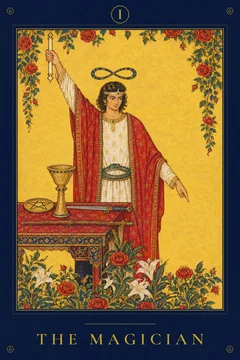
The Magician stands behind his table with a wand raised to the sky and his other hand pointing to the ground, the four suit tools laid before him. Everything she needs is already on the table: a trained hand and eye, and materials sitting in a drawer. Waite speaks of the communication of the powers and gifts of the spirit. A Major in the supporting place says her skill is the strongest force in the spread, and it asks her to pick up one tool and use it.
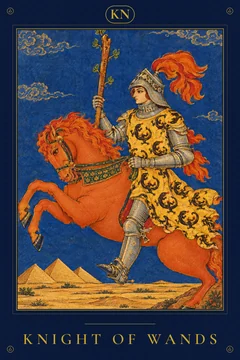
Upright, an armoured rider on a rearing horse holds his wand high, salamanders on his tunic and three pyramids behind. Reversed, Waite gives rupture and interruption, the gallop that breaks off halfway. Her obstacle is her own enthusiasm: ten drawings in the first two days and none by day nine. Intention and obstacle are both Wands, and that is the lesson of this spread, since the fire that lights the start can also burn it out. One drawing a day is the limit, even on the good days.
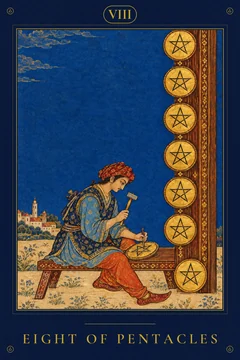
A craftsman bends over his bench hammering a pentacle, six finished discs hung on the post beside him and one more at its foot, the town far behind. By the end of the cycle the spark of the Ace has become a daily craft. Waite reads skill in craft, perhaps still in the preparatory stage, which is exactly right for a month of plain pages counted by the number finished. The Eight of Pentacles is the Ace of Wands brought down to earth.
Synthesis
The suits pair off. Wands sit in the intention and the obstacle, Pentacles in the release and the outcome, and the Magician, a Major ruled by Mercury, holds the middle as the support.
The Wands pair cuts both ways. The same fire that offers the Ace's living wand drives the Knight's horse too hard. What she needs is a pace.
The Pentacles pair is the more interesting one. In the release position a man sits on his coins and guards them. In the outcome a man makes coins one at a time and hangs them on a post for anyone to see. Same suit, opposite postures: gripping and making. The month's work is the move from one to the other.
The numbers point the same way. An Ace and the Magician, card I, put two ones in five cards, which keeps the whole spread at the starting line. Only one card is reversed, the Knight, so the main resistance comes from inside the plan and not from her circumstances.
The plain answer: set the intention of one drawing each morning until the next new moon, shown to one person by the end. Tonight, put a sketchbook and a single pen on the table by her bed, a small Magician's table, and nothing else. At the full moon she can lay the full moon spread on the same question and see what has grown.
Before you lay it
Common mistakes
Setting an intention too large for one lunar month. Shrink it until you could do it on your worst day, and let the next new moon add to it.
Reading the obstacle as a reason to give up the plan. Look at the supporting card for the answer, and change the method rather than the aim.
Treating the new moon as a deadline that, once missed, wastes the month. A day or two after the new moon serves just as well, and so does the first evening you notice the crescent.
Laying the spread and never checking it. Write the intention down and read it again at the full moon, with the full moon spread on the same question.
Premium
The New moon spread and every other spread, unlimited
Why is the new moon a good time for a tarot reading about intentions?
Because the moon's light grows from here for about two weeks. Setting an intention as the light begins to increase gives you a plain, visible rhythm to work with: plant now, and check what has grown at the full moon. The symbolism is simple and needs no belief beyond the calendar.
My family avoids starting new work on Amavasya. Can I still use this spread?
Yes. Many families keep Amavasya as a quiet day, and you can honour that by laying the spread the following evening, when the first crescent is visible. The spread follows the growing light, so the day after the new moon is as fitting as the night itself.
Should the new-moon intention be about one area of life only?
One area is best, and one aim within it. A single intention gives every card a clear job; several intentions blur the obstacle and the outcome. If you have more than one wish, choose the one you can act on tomorrow morning.
How does the New moon spread work?
You ask your question, shuffle, and choose 5 cards. Each card is read in its position, then the reading closes with a synthesis that joins them.
Is the reading free?
Today's card, yes or no, past-present-future and the Celtic Cross are free, three readings a day without an account. The other spreads are part of Premium.
What does a reversed card mean?
A reversed card is the same energy turned inward, delayed or asked for differently. TarotPandit never reads it as a closed door: every reversal names a step.
Are the readings in Hindi?
Every reading comes in English and Hindi. Use the language button to choose which leads.