
Sooner or later a card will come out of the deck upside down, and you will have to decide what that means. Readers disagree about reversals more than about almost anything else in tarot, and a beginner who switches from one approach to another between readings will contradict themselves. This lesson sets out the main schools, asks you to choose, and gives you the register TarotPandit uses on every card page.
What a reversal is
A card is reversed when it lands with its picture upside down from the reader's point of view. Reversals happen naturally when a deck is shuffled by turning portions of it around; some readers ensure them by rotating half the deck before each shuffle. Others keep every card upright and read without reversals at all, drawing the nuance from neighbouring cards instead. Both practices are legitimate. If you do use reversals, you need a clear idea of what the turn adds.
Whatever you decide, avoid the most common beginner's error: treating a reversed card as the bad version of an upright card. A reversed card is still the same card. Its energy is present; it is moving differently.
The main schools of reversal
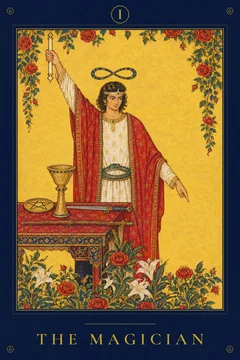
The names below are a modern way of grouping what readers actually do. Each school sees the reversed card as the same energy, changed in a particular way. To make them concrete, apply each to the Magician, whose upright meaning you studied in Lesson 5: will that has found its method.
- Blocked. The energy is present but cannot flow. Reversed Magician: the skill is there, but something stands in the way of using it, perhaps a missing resource or a lack of confidence.
- Inner. The energy is turned inward, working in private before it shows outwardly. Reversed Magician: the skill is being developed quietly and is not yet ready to be shown.
- Delayed. The energy will arrive, but not yet. Reversed Magician: the moment to act is coming, and preparation is the work of now.
- Excess or lack. The energy is too strong or too weak. Reversed Magician: either talent spread across too many projects, or the same gift of speech turned to manipulation; at the other end, a skill underused.
- Opposite. The reversal means the contrary of the upright card. Reversed Magician: no method, no skill, deception. This is the oldest and bluntest school, and the one most likely to frighten a querent if used carelessly.
Notice that the library's own reversed reading of the Magician gathers several of these at once: the scattered table, the trickster, and the plan without action. A skilled reader often lets the spread and the question decide which shade is meant.
Choosing one approach
Choose your approach before you shuffle, not after you see the card. A reader who decides afterwards will pick whichever reading feels most comfortable, and that is not reading. Write your choice at the front of your notebook and keep it for at least the thirty days of practice in the next lesson.
A sound beginner's path is to use reversals and read them in the TarotPandit register described below, which draws mainly on the inner, delayed and excess schools. If you prefer to read without reversals for your first month, that is a serious choice too; note it, and pay closer attention to the cards on either side of each card.
The TarotPandit register: a reversal names a step
On every card page in this library, a reversal is read as energy turned inward, delayed or excessive, never as a closed door. The reversed card names the step the querent can take to bring that energy back into flow.
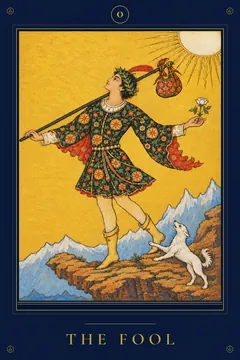
Take the Fool. Upright, it is a beginning taken in good faith. Reversed, the library reads it as the same leap taken without looking, or not taken at all. Neither reading says "you will fail". The first asks the querent to look at the ground before stepping; the second asks what fear has postponed the step. Each names something to do.
Apply the same principle to any reversal:
- State the upright energy in one sentence.
- State how it is moving: inward, delayed, too much or too little.
- State the step that would restore it.
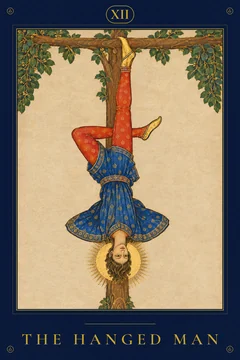
Avoid telling a querent "this card is reversed, so it is bad". Say instead what the energy is doing and what would help it move. Even a card that already shows inversion, such as the Hanged Man, suspended upside down, is read this way: reversed, it can show a pause that has gone on longer than it serves, and the step is to end the waiting.
Exercise
Allow twenty minutes.
- At the front of your notebook, write your reversal approach in two sentences: whether you will use reversals, and which register you will read them in.
- Choose three cards whose upright meanings you know: one Major, one Minor numbered card and one court card.
- For each, write the three lines from the method above: upright energy, how it moves when reversed, and the step that restores it.
- Read your three reversed readings aloud as if to a querent. Underline any phrase that sounds like a verdict, and rewrite it as a step.
Take the quiz and keep your place
Sign in or create a free account to answer this lesson's quiz, record your progress and earn the Foundation certificate.