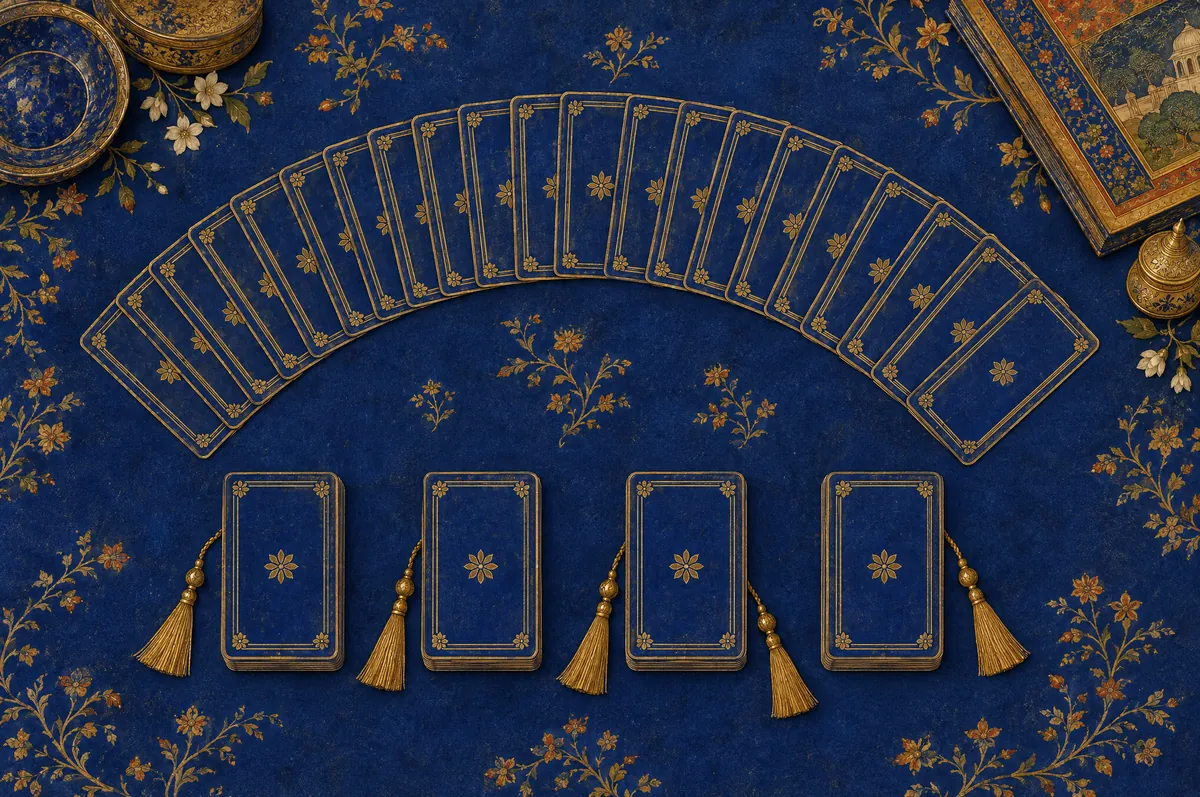
A reader who knows the structure of the deck can read a spread before interpreting a single card. How many trumps are on the table, which suits dominate, which court figures appear: each of these tells you something about the question at a glance. This lesson lays out the 78 cards, explains how they are numbered, and answers a question every attentive student eventually asks: why Strength and Justice sit where they do in the 1909 deck.
Seventy-eight cards in two families
The deck divides into the Major Arcana, 22 cards, and the Minor Arcana, 56 cards. Arcana is the plural of the Latin arcanum, a secret; the names are later labels, but they have stuck.
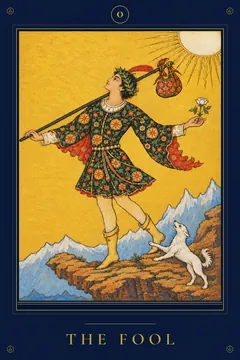
The Major Arcana are the trumps of the old game. Each has a name and a figure: The Fool, the Magician, the High Priestess and so on to the World. In the 1909 deck they carry Roman numerals from 0 to XXI. They speak of the large themes in a life: a beginning, a test of will, an ending, a long-awaited clarity.
The Minor Arcana describe the situations, efforts, feelings and people through which those themes are lived. If a Major card names the chapter, the Minor cards describe the scenes.
A common working rule follows. When Major cards make up much of a spread, the question touches a larger chapter of the person's life and deserves to be treated that way. When the spread is almost all Minor cards, the matter is closer to daily life and more within immediate control. Treat this as a first impression to test against the cards themselves.
The Minor Arcana: four suits of fourteen
There are four suits: Wands, Cups, Swords and Pentacles. Each suit holds fourteen cards:
- Ten numbered cards, often called pips, from Ace to Ten. The Ace is the seed of the suit, its energy in pure form. The Ten is that energy carried to its fullest point, where a cycle completes and something new must begin. The numbers between trace the stages of growth; a later course gives each number its full lesson.
- Four court cards: Page, Knight, Queen and King. A court card can show a person in the querent's life, or a way of acting that the querent is being asked to adopt.
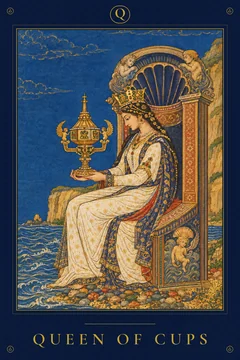
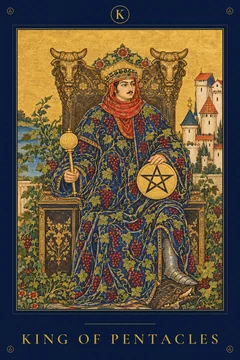
In this library each court rank carries an element of its own: the King is Fire, the Queen is Water, the Knight is Air and the Page is Earth. Other systems differ, and the Golden Dawn itself used different court titles; whichever system you use, use it consistently. Combine the rank's element with the suit's element and the court card becomes precise. The Queen of Cups is Water of Water: feeling turned inward, deep and receptive. The King of Pentacles is Fire of Earth: will applied to material building. You will meet the suit elements in the next lesson.
How the numbering works
Every Major card in the 1909 deck carries its numeral at the top of the painting. The Fool is 0, which places him outside the count. He can be laid before the Magician at the start of the sequence or after the World at its end, and both readings have their teachers. Zero is the number before counting starts; the Fool is the traveller who has not yet taken the first step.
The Minor cards are numbered by their pips, and the courts are ranked from Page up to King. When you lay a suit out in order, Ace to Ten and then the four courts, you see the suit as a story: an impulse, its development, its testing, its fulfilment, and the people who carry it.
Why Strength is VIII and Justice XI
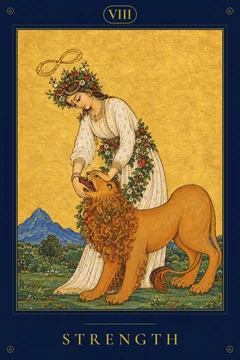
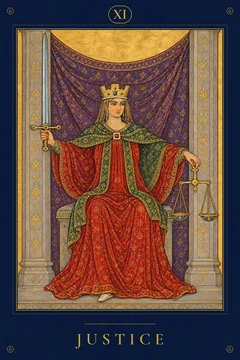
In the older Marseille order, Justice is VIII and Strength is XI. In the 1909 deck the two have exchanged places: Strength is VIII and Justice is XI.
The reason lies in the Golden Dawn system. The order attributed each trump to a Hebrew letter in sequence, and through those letters to an element, a planet or a sign of the zodiac. Strength was given to Leo and Justice to Libra. The Chariot before them was given to Cancer and the Hermit, IX, to Virgo. With Justice at VIII, the zodiac would run out of order. With Strength at VIII and Justice at XI, the signs follow their natural sequence: Cancer, Leo, Virgo, and after the Wheel, Libra. Waite was a member of the order and adopted this arrangement. In The Pictorial Key to the Tarot he notes the exchange and declines to explain it, saying in effect that the change would mean nothing to the ordinary reader.
Two practical lessons follow. First, read a card by its name and image, never by its numeral alone: in a Marseille deck, VIII is Justice. Second, when you work with the numbers of the trumps, for example in a numerological reading, use the numbering of the deck you are reading with, and say which it is.
Exercise
Allow twenty-five minutes. Use a physical deck if you have one; otherwise open the card pages on this site.
- Separate the Major Arcana from the Minor Arcana. Count each pile and confirm 22 and 56.
- Lay out the Majors in numerical order. Find VIII and XI and write one sentence on why they sit there in this deck.
- Divide the Minors into four suits and lay each one out from Ace to Ten, followed by Page, Knight, Queen and King. Confirm fourteen in each.
- Choose any four court cards, one from each rank. For each, write its double element (for example, "Knight of Cups: Air of Water") and one line on what that combination might look like in a person.
- Shuffle and deal ten cards face up. Count the Majors and write one sentence on whether this spread feels like a chapter or a scene.
Take the quiz and keep your place
Sign in or create a free account to answer this lesson's quiz, record your progress and earn the Foundation certificate.