Knowledge of tarot becomes skill only through practice, and practice becomes skill only when it is recorded and reviewed. A student who draws a card every day for a month and writes nothing down has had thirty pleasant moments. A student who keeps a journal has thirty data points, can see patterns in their own reading, and can measure their progress. This lesson sets up your practice for the next thirty days.
The daily single card
Begin with one card a day. Draw it in the morning, physically or at /readings/daily, and treat it as the quality the day asks of you. A single card is the best training there is: you cannot hide behind combinations, and you must read one image fully.
Use the method from Lesson 5. Look first. Note the figure, gesture, direction, colour, objects and counts, then the meaning. Then ask one question: what is one small thing I can do today that meets this card? Write the answer down.
In the evening, return to the entry and write two or three lines on how the card showed up, if it did. Some days the connection will be clear, some days faint, and some days absent. Record all three honestly. A journal that only keeps the hits teaches you nothing.
The journal entry
Keep each entry short and in the same format, so that the review in thirty days is easy. Use these lines:
- Date.
- Card, and whether it is upright or reversed.
- First image noticed, with its marker number from the card page if you checked it.
- Meaning in one sentence, in your own words.
- One action for today.
- Evening note: how the card appeared, or that it did not.
If you draw at TarotPandit, your readings are also saved at /account/readings. Use that record to check dates and cards, but write your observations in your own notebook; the act of writing is part of the training.
Past, present, future
Once a week, after your daily draw, lay a three-card spread at /readings/past-present-future or with your own deck. The positions are simple: where you were, where you stand, and where the present course leads if nothing changes. That last phrase, which you met in Lesson 1, is what keeps the third card from becoming a fixed prediction. It describes a direction, and the querent's choices can change it.
Read the three cards as a sentence rather than as three separate meanings. What connects the past card to the present one? Does the future card continue the movement or reverse it? Count the suits, as you learned in Lesson 3, and note which element is missing.
Case study
A student, whom we will call A., was working full time and studying for a professional qualification in the evenings. She had stopped attending classes three weeks earlier and asked: "What do I need to understand about my studies right now?" She drew a past, present, future spread.
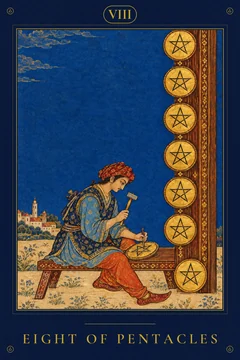
- Past: Eight of Pentacles, upright. A craftsman sits at his bench carving coins, with finished ones hung up beside him.
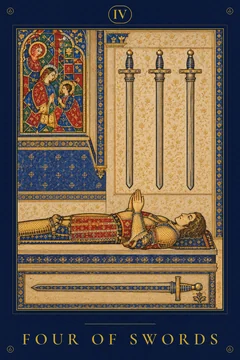
- Present: Four of Swords, upright. A knight lies in effigy on a tomb, hands joined in prayer, three swords hanging on the wall above him and a fourth carved along the side of the tomb.
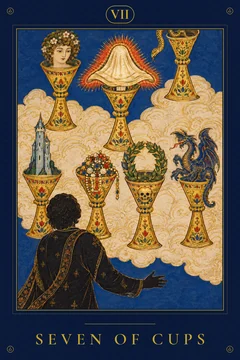
- Future: Seven of Cups, upright. A figure faces seven cups floating in clouds, each holding a different vision.
A skilled reader works through it like this. The past card is steady, patient work: she had been a diligent student, and the finished coins show real progress. The present card is rest and retreat. It is not failure; the knight is resting, not dead, and the card is often read as recovery. Her three weeks away are a pause her body and mind may well have needed.
The future card is the warning, and it is gentle. If nothing changes, the pause drifts into daydreaming: seven appealing options, none chosen. The reader notes that the spread holds Earth, Air and Water but no Fire. The will to return is the missing element.
The reading closes with a step. Avoid "you will give up"; say instead "the rest has done its work; choose a return date before the options multiply". A. set a date two weeks away and wrote it in her journal.
The thirty-day review
At the end of thirty days, set aside an hour. Go through every entry and count:
- How many Major and how many Minor cards you drew.
- How many of each suit, and which element was most and least present.
- Which cards repeated, and how often.
- How many reversals, if you use them.
- On how many evenings the card was clearly present, faintly present or absent.
Then write one page answering three questions. What patterns do I see in the cards? What patterns do I see in my reading, such as cards I always read the same way or details I keep missing? What will I do differently in the next thirty days?
Exercise
Begin today, and allow ten minutes each morning and five each evening.
- Prepare your notebook: write the six journal lines at the top of a fresh page so you can copy the format.
- Draw your first daily card and complete lines 1 to 5.
- Tonight, complete line 6.
- Mark a date thirty days from today in your notebook and calendar for the review.
- Choose one day each week for a past, present, future spread and write it down now.
Take the quiz and keep your place
Sign in or create a free account to answer this lesson's quiz, record your progress and earn the Foundation certificate.