Most beginners learn tarot by memorising keywords, and most stall there. Keywords are someone else's summary of a picture. When you read the picture yourself, the meaning becomes yours, you remember it without effort, and you notice details that fit the querent in front of you. TarotPandit teaches one habit above all others: look before you interpret.
Why the picture comes first
The 1909 deck was designed to be read by eye. Pamela Colman Smith painted a full scene on every card, and Waite's Pictorial Key describes those scenes before it gives meanings. The symbols carry the meaning; the keywords were drawn from them afterwards. If you go straight to a keyword, you skip the source and keep only the summary.
There is a second reason. A querent can see the card. When you say "notice that his hand points down to the earth", they look, they see it, and the meaning lands in a way that "this card means manifestation" never does. Pointing to the picture also keeps you honest: every statement you make is tied to something visible.
The TarotPandit method
Work through the card in this order. Do not skip ahead to meaning until the last step.
- The figure. Who is in the card? How many people or beings? Young or old, standing or seated, clothed how?
- The gesture. What are the hands doing? Holding, offering, pointing, resting, hidden?
- The direction. Which way does the figure face or move: towards you, away, to one side, up, down? Some readers attach fixed meanings to left and right; treat those as conventions, and begin with what the figure is plainly doing.
- The colour. What colours dominate? What is the background: open country, a sky, a flat field?
- The objects and their counts. What is in the card, and how many? Count everything: cups, stars, swords, flowers, steps. Numbers in the 1909 images are rarely accidental.
- The meaning. Only now ask what these observations add up to, and check your reading against the card page.
On TarotPandit every card page at /cards/<slug> carries numbered markers on the painting, one for each symbol, with a short lesson beside it. Use them after you have done your own looking. Compare what you saw with what the markers point to, and note what you missed.
A worked example: the Magician
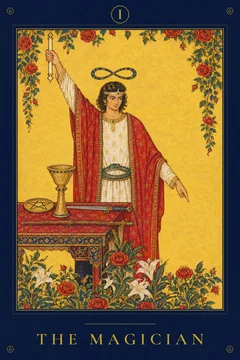
Open The Magician and keep the painting beside you.
The figure (marker 1). One young man, standing behind a table. In the first row of trumps the other robed and crowned figures sit; he alone stands. Before reading any text, a standing figure suggests action and readiness.
The gesture (markers 2 and 6). His right hand raises a short white wand towards the sky. His left hand points down to the earth. The two arms make one line from above to below. Waite reads this double gesture as the descent of power from higher things to lower ones. In plain terms: inspiration received, then put to work.
The direction. He faces us squarely, eyes level. Nothing is turned away or hidden. This is a card of open, conscious effort.
The colour (markers 7 and 8). A white robe under a red mantle: purity of intent beneath active will. The background is a flat yellow field with no scenery, which the card page reads as attention itself, the daylight mind. Red roses and white lilies repeat his colours in the garden at his feet.
The objects and their counts (markers 3, 4 and 5). Above his head, a horizontal figure of eight. Around his waist, a serpent biting its own tail. On the table, exactly four objects: a cup, a sword, a pentacle and a wand, the emblems of the four suits you met in Lesson 3. He holds none of them.
The meaning. Now put it together. A man who has every element of life within reach, who stands ready, who draws power from above and directs it to the ground, and who has not yet picked up a tool. The card is will that has found its method: skill, concentration, resourcefulness. It also carries a quiet question: which of the four tools does the work in front of you need? A querent who draws the Magician about a stalled project is being told that the resources are on the table and asked to choose one and begin.
Notice how much of that came from looking. The keywords on the card page (willpower, skill, manifestation, concentration, resourcefulness) now have a picture behind each one.
Echoes across the deck
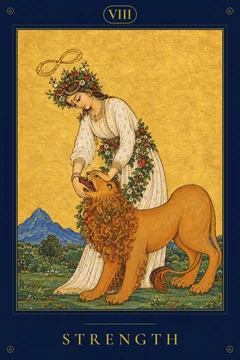
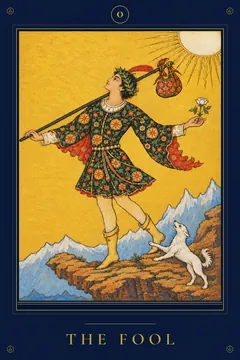
Once you read symbol first, you begin to see symbols return. The figure of eight above the Magician floats again above the woman in Strength. The white rose the Fool carries returns on the banner of Death. Each return links two lessons. Record these echoes in your notebook as you find them; they will become one of your most useful tools.
Exercise
Allow twenty minutes. Choose one Major card you have not studied yet.
- Set a timer for three minutes and look at the painting without reading anything. Write nothing yet.
- Write six headings: Figure, Gesture, Direction, Colour, Objects and counts, Meaning. Fill in the first five from your own observation only.
- Under Meaning, write three or four sentences on what the card says, built from your observations.
- Open the card page and go through the numbered markers. Tick each symbol you noticed and circle each one you missed.
- Write one sentence on the most important detail you missed and what it adds.
Take the quiz and keep your place
Sign in or create a free account to answer this lesson's quiz, record your progress and earn the Foundation certificate.