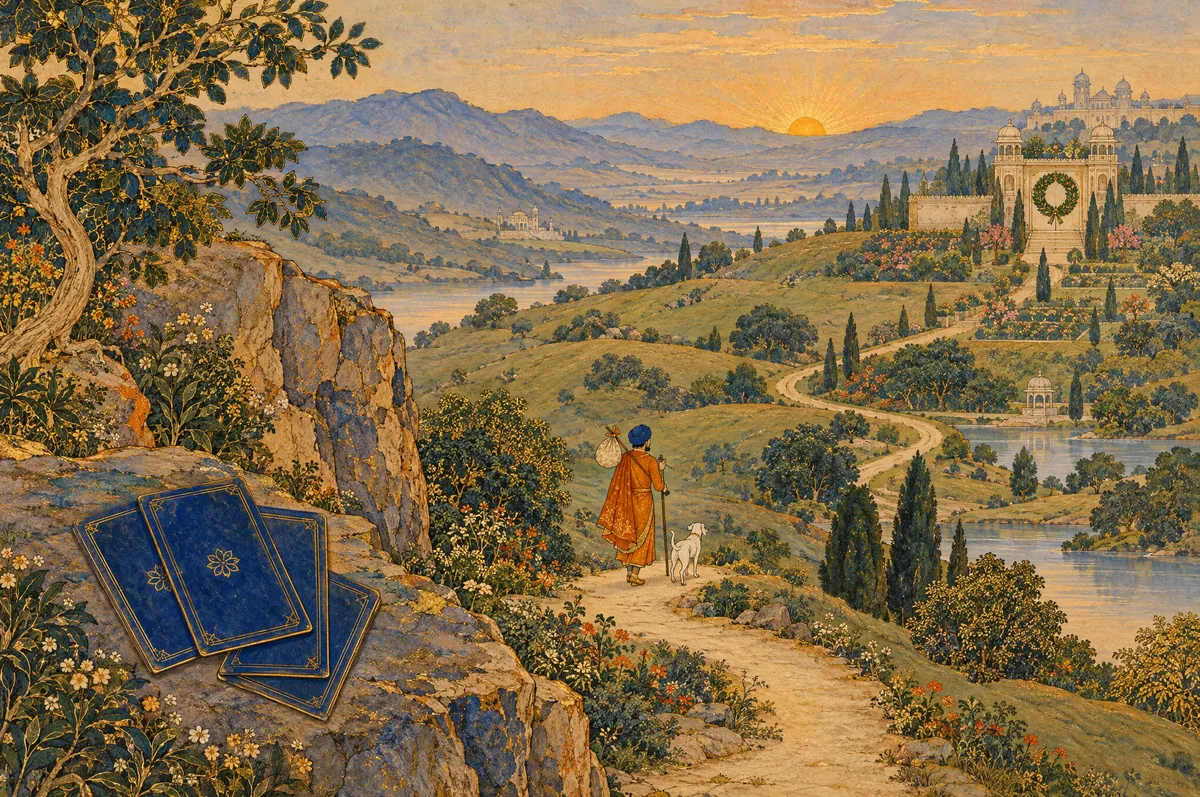
Twenty-two cards are easier to remember as a road than as a list. When you see the trumps as stages of a single life, each card gains a place, a before and an after, and you begin to read a Major card in a spread as a signpost: this is where the querent stands on a longer road. This lesson gives you that road, a teaching device for walking it, and the three turning points every reader must handle with care.
The trumps as stages of a life
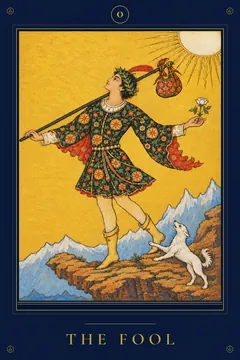
The Fool, numbered 0, is the traveller. He stands at the edge of a cliff with a small bundle, a white rose and a dog at his heel, and the whole deck lies ahead of him. In the reading of the trumps as one continuous story, often called the Fool's journey, each card he meets is a teacher, and each lesson prepares him for the next. The name and the story are a modern teaching device, not a doctrine from Waite or the Golden Dawn, but they work, because they mirror how a real life unfolds.
He meets the Magician, who shows him that his bundle holds every tool he needs. He learns inner knowing from the High Priestess, abundance from the Empress, structure from the Emperor, tradition from the Hierophant, choice from the Lovers and controlled direction from the Chariot. Later he must find courage, solitude, acceptance and balance. Later still he faces what binds him, watches false structures fall, and finds hope, then clarity, then a reckoning and, at last, completion in the World, where the journey can begin again.
Three rows of seven
A modern teaching device lays the Fool apart and arranges the twenty-one numbered trumps in three rows of seven. It is a classroom tool, not a rule from the 1909 sources, but it gives the sequence a visible shape.
- Row one, I to VII, the self in the world. Magician, High Priestess, Empress, Emperor, Hierophant, Lovers, Chariot. These cards concern skill, knowledge, nurture, authority, learning, relationship and the will to move forward. They are the lessons of growing up and taking a place in society.
- Row two, VIII to XIV, the inner work. Strength, Hermit, Wheel of Fortune, Justice, Hanged Man, Death, Temperance. Here the questions turn inward: courage of the heart, solitude, change beyond control, fairness, surrender, letting go, and the patient blending of opposites.
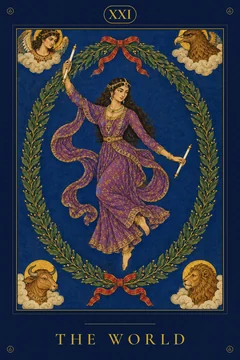
- Row three, XV to XXI, the larger forces. Devil, Tower, Star, Moon, Sun, Judgement, World. These cards meet what lies beyond personal effort: attachment, upheaval, hope, uncertainty, clarity, awakening and completion.
Read vertically, the rows also speak to each other. The Magician (I) heads the first row and Strength (VIII) the second; the figure-of-eight sign floats above the head of each. Use the layout to find such echoes, and record the ones you discover.
Three turning points
Three cards on this road mark sharp turns. Handled clumsily, they frighten querents. Handled well, they are among the most useful cards in the deck.
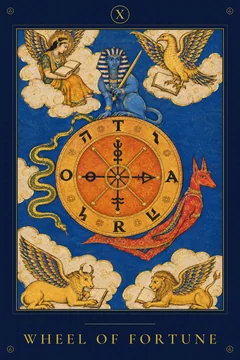
Wheel of Fortune, X. Near the centre of the sequence, a great wheel turns in the sky with figures rising and descending on it, and four winged creatures read in the clouds at the corners. This is change that arrives on its own schedule: a market shifts, a manager leaves, a season ends. The question it asks is what the querent will do on the turn. Avoid saying "luck is coming" or "luck is leaving"; say instead which way the wheel seems to be turning and what preparation suits it.
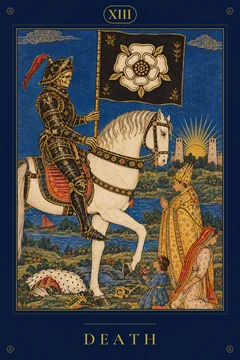
Death, XIII. An armoured skeleton rides a white horse and carries a black banner bearing a white rose; figures of every station stand or fall before it, and a sun rises between two towers in the distance. The card is an ending that clears ground for what follows. It is almost never about physical death, and TarotPandit never reads it as a prediction of one. Say what is ending, and what the cleared ground makes possible.
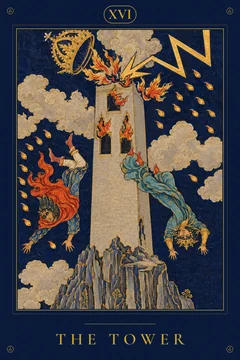
The Tower, XVI. Lightning strikes a tower on a rocky peak, the crown is knocked from its top, and two figures fall through the air among flames. A structure built on a false premise comes down suddenly: a plan, a belief, an arrangement that could not hold. Avoid calling it disaster. Say that what was false is falling, that what is true will survive it, and ask the querent what they had been defending.
Reading a Major in a spread
When a trump appears, place it on the road. Which row is it in? What card comes just before it in the sequence, and what lesson has the querent perhaps already learned? What card comes after, and what is being prepared? A querent who draws the Hermit has passed through Strength and is approaching the Wheel: the solitude is a preparation for change, not an exile. This one habit will give your readings of the Majors depth that a list of keywords cannot.
Exercise
Allow thirty minutes.
- Lay the Fool at the top of your table. Below him, lay the twenty-one numbered trumps in three rows of seven.
- For each row, write one word that sums it up in your own understanding. Then write one sentence on a time in your life that belonged to each row.
- Find one vertical echo between cards in the same column, as with the Magician and Strength. Write down what links them.
- Take the Wheel, Death and the Tower. For each, write one sentence a frightened querent might say on seeing it, and then the calm, accurate sentence you would reply with.
- Keep the layout photograph or a sketch in your notebook for later lessons.
Take the quiz and keep your place
Sign in or create a free account to answer this lesson's quiz, record your progress and earn the Foundation certificate.