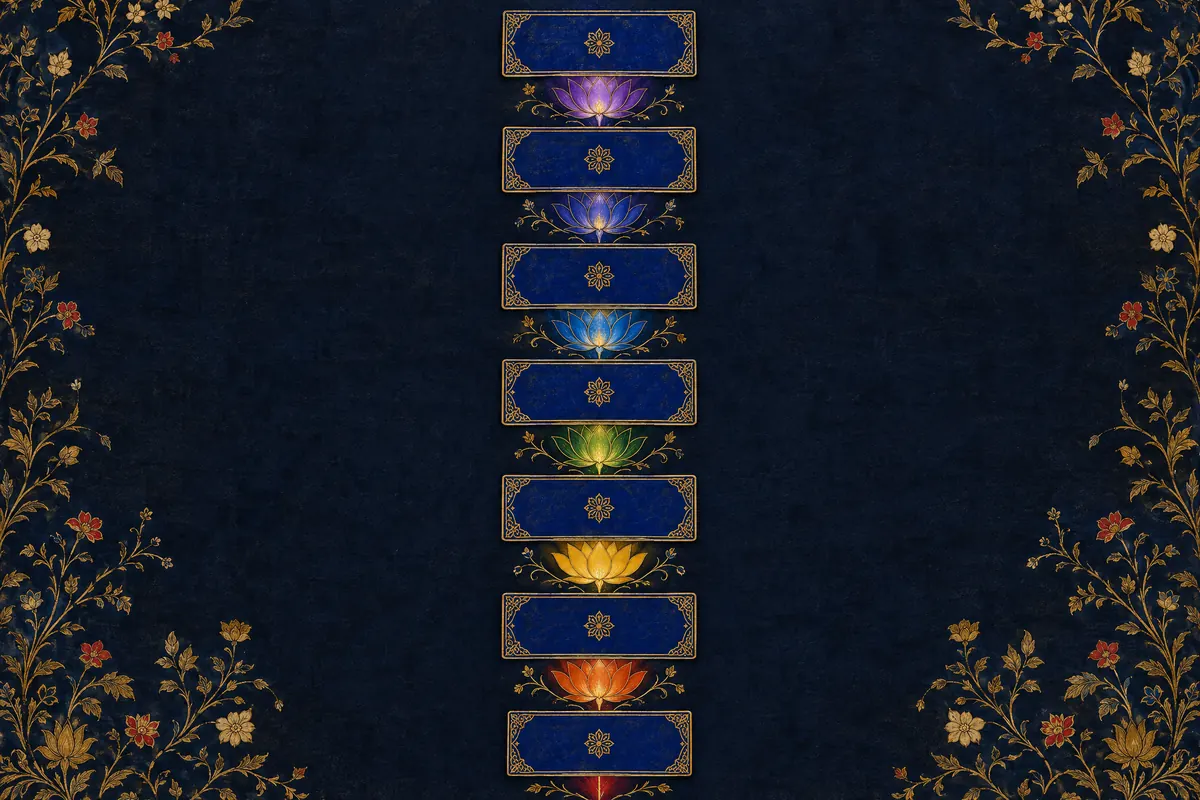
Seven centres from root to crown, one card each, read as an interpretive map of where energy flows freely and where it waits.
मूलाधार से सहस्रार तक सात केंद्र, हर एक का एक कार्ड, एक व्याख्यात्मक मानचित्र की तरह कि ऊर्जा कहाँ मुक्त बहती है और कहाँ रुकी है।
Root: Muladhara
Sacral: Svadhishthana
Navel: Manipura
Heart: Anahata
Throat: Vishuddha
Brow: Ajna
Crown: Sahasrara
Premium spread
Seven centres, seven cards.
The Chakra spread is part of Premium. Premium opens every spread, unlimited, with the five areas of life on every card and a sealed PDF of each reading.
₹299 a month, or ₹1,999 a year (save 44%), less than ₹6 a day
Each card is read in its position from the TarotPandit library: the card speaks, the position, the cards together, and practical guidance, in English and Hindi, closing with a synthesis.
The guide
When to use this spread
This is a modern pairing of tarot with the yogic map of seven chakras, and not a classical tarot layout: the 1909 deck was drawn without chakras in mind, and the combination came much later. Read it as a reflective map of where your energy moves freely and where it stalls, with one card for each centre from root to crown. It suits a period of general unsettlement, after a move or a long effort, when you cannot quite name what is wrong. It is a tool for attention and makes no diagnosis. For a plainer look at habits and rest, the health spread is simpler, and for a pattern hidden in yourself, try the shadow-work spread.
The numbers match the positions listed alongside
By hand
How to lay it out
Lay the seven cards in a single vertical column, like a spine. The root card goes nearest you and each card after it goes above the last, so the crown lies furthest away. Lay them face down in order from root to crown, then turn them in the same order. Read the column once from the bottom up. Then sit back and look at it whole for clusters: two reversals in the lower half say something quite different from two scattered through it.
What each position asks
1
Root: Muladhara मूलाधार
The base of the spine in the yogic map, and the centre of ground and of belonging to a place. It sits nearest you because every centre above stands on it. A reversed card here often shows a routine or a home that has not yet settled.
2
Sacral: Svadhishthana स्वाधिष्ठान
The centre of pleasure and creative flow, placed just above the root. Read it for how freely you enjoy things and make things. A dry or reversed card here suggests pleasure postponed until some later, better time.
3
Navel: Manipura मणिपुर
The fire at the navel, which the yogic map links with will and with confidence in action. It sits at the top of the lower three, where effort is generated. Ask whether you are acting from strength or from strain.
4
Heart: Anahata अनाहत
The middle of the seven and the hinge of the column, with three centres below and three above. It reads the capacity to give and receive affection. A card here tends to colour the whole reading, so look at it twice.
5
Throat: Vishuddha विशुद्ध
The centre of speech and honest expression. It sits above the heart because, in this map, what the heart holds is given voice here. Look for words held back, or words spoken too fast.
6
Brow: Ajna आज्ञा
The centre between the eyebrows, associated with insight and inner sight. It reads what you know without being told. Major Arcana cards of intuition, such as the High Priestess or the Moon, speak loudly in this place.
7
Crown: Sahasrara सहस्रार
The crown of the head, the thousand-petalled lotus, and the centre of connection to whatever you hold larger than yourself. It sits furthest from you because it is the least tangible of the seven. Read it gently, as a direction of faith or meaning, never as a score.
One reading, start to finish
A worked example
A 47-year-old bank manager transferred from Kolkata to Pune four months ago, living alone in a rented flat while his family finishes the school year.
"Since the transfer I feel unsettled. Where is my energy stuck, and where is it flowing?"
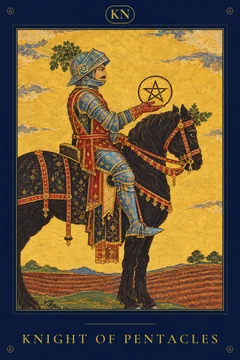
Upright, an armoured knight sits still on a heavy black horse, a pentacle held out on his open hand and ploughed fields behind him: steady, dependable routine. Reversed, the horse that stood ready simply stands, and Waite's words for it include inertia and stagnation. Four months into a rented flat, his days have no shape, with meals at odd hours and weekends that dissolve. The root is waiting for a routine. The remedy is the knight's own: one fixed daily task, kept, and then one small change to it.
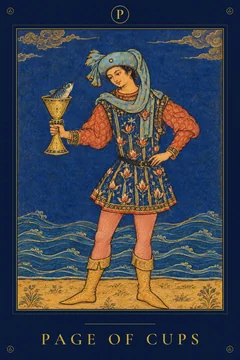
A young page in a lotus-patterned tunic stands on the shore holding out a golden cup, and a fish rises from it to look back at him. Here energy is moving. Something in the new city has stirred his curiosity, perhaps a music class he passes each evening, or the plain pleasure of streets he does not yet know. The card asks him to meet that surprise with curiosity, and to set aside the guilt he feels at enjoying anything while his family is away.
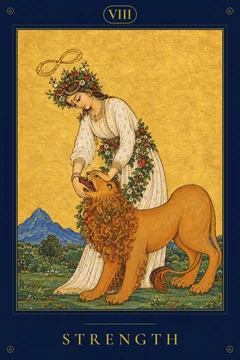
A woman in white bends over a tawny lion and closes its jaws with her bare hands, a lemniscate above her head. Reversed, the hands withdraw. Waite's reversal carries weakness as well as force misused, and for this querent it is the first: a capable officer who, in a new branch with new staff, has stopped trusting his own judgement and defers on everything. The card's remedy is small and daily. Put one hand back on the animal by making one decision a day without consulting anyone, and letting it stand.
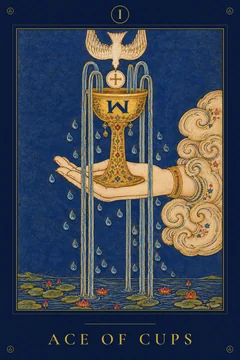
A hand from a cloud holds a golden chalice, five streams pouring from it into a pond of water lilies while a dove descends with a wafer. The heart is full. His affection for his family, and theirs for him, is the strongest current in the reading, and the card says it is flowing even at a distance. Waite gives the Ace to a heart that is true and content. This centre needs nothing mended, and its overflow can be lent to the centres beneath it.
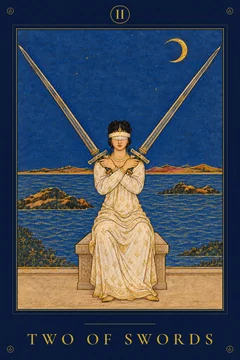
A blindfolded woman sits by the sea with two long swords crossed over her chest and a thin crescent moon above. The swords cross just over the heart, so the throat card is guarding the heart card beneath it. He has not told his family how lonely the posting is, nor told his regional head that the branch needs another officer. Waite reads friendship held in an armed truce. The stillness has served him, and the card now asks him to set a date by which he will say both things.
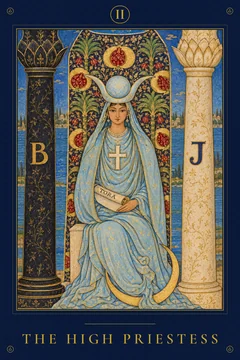
A woman sits between a black pillar and a white one, a horned crown on her head and a scroll marked TORA half hidden in her lap. Insight is clear. He already knows what the unsettlement is about and has not yet let himself say it, which is the Priestess's own condition: knowledge held in silence. She asks for stillness and for a written record of what he actually knows. Ten quiet minutes before sleep, with a notebook open, would let the knowing reach the page.
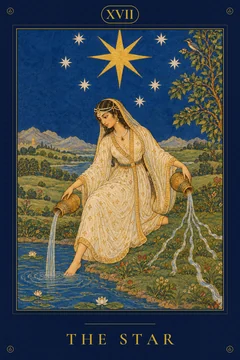
A woman kneels at a pool under a great eight-pointed star, pouring one jug into the water and the other onto the land. The crown is open. Whatever gives his life meaning, his faith or his sense of what the move is for, is intact and quietly renewing him. The Star follows the Tower in the sequence as the calm after disruption, which fits a man four months past an upheaval. Hope at the crown is a resource the lower centres can draw on.
Synthesis
Look at the column as two halves. From the heart to the crown every card is upright, and those four belong to Water and Air alone. His inner life is moving well. The lower half tells another story. Both reversals sit below the heart, at the root and at the navel, the centres of ground and of will. This is a familiar shape after a move: feeling and faith travel easily, and the daily footing gets left behind. The navel card is Strength, which the Golden Dawn gives to Leo, so the fire that belongs at Manipura is present and only held back. Between the two reversals the Page of Cups shows the way through, since a small pleasure is already stirring at the sacral centre. Look at the throat as well. The Two of Swords crosses its blades over the chest, just above the brimming cup of the heart, which means a full heart is being kept silent. The plain answer is that his energy is stuck in routine and in confidence, and flowing in affection and insight. One step for this week: the same evening walk and the same dinner hour every day, and on Sunday a phone call in which he tells his family plainly how the posting feels.
Before you lay it
Common mistakes
Presenting the chakra spread as an ancient tarot tradition. Say plainly that it is a modern pairing of tarot with the yogic chakra map, and use it as a reflective tool.
Reading a reversed card at a centre as a blocked organ or an illness. Read it as attention needed in that area of life, and take any physical concern to a doctor.
Reading the seven cards one by one and never looking at the column. Step back and see where the reversals or a single suit gather, because the clusters carry the message.
Trying to mend every centre at once. Choose the lowest centre that needs care and begin there, since the column is built from the ground up.
Premium
The Chakra spread and every other spread, unlimited
No. Tarot and the yogic chakra system come from different traditions, and laying one card for each chakra is a modern combination. TarotPandit offers it as an interpretive map, and every card is read with its usual meaning from the 1909 deck.
Which tarot suits go with which chakras?
There is no fixed rule, and different books print different tables. We read the card first and the centre second. As a working habit, Pentacles sit comfortably at the root and Cups at the sacral and heart centres, while Wands suit the navel and Swords the throat, but any card can appear anywhere and still make sense.
How does the Chakra spread work?
You ask your question, shuffle, and choose 7 cards. Each card is read in its position, then the reading closes with a synthesis that joins them.
Is the reading free?
Today's card, yes or no, past-present-future and the Celtic Cross are free, three readings a day without an account. The other spreads are part of Premium.
What does a reversed card mean?
A reversed card is the same energy turned inward, delayed or asked for differently. TarotPandit never reads it as a closed door: every reversal names a step.
Are the readings in Hindi?
Every reading comes in English and Hindi. Use the language button to choose which leads.