Forty of the seventy-eight cards are pips: Ace to Ten in four suits. A beginner learns them one at a time, as forty separate meanings. An intermediate reader learns them as ten numbers and four elements, and from those fourteen ideas can rebuild any pip, including one whose meaning slips away in the middle of a reading. This lesson gives you the numbers as a sequence, shows how each number takes the colour of each suit, and adds the Golden Dawn titles as a second handle.
Ten numbers as one story
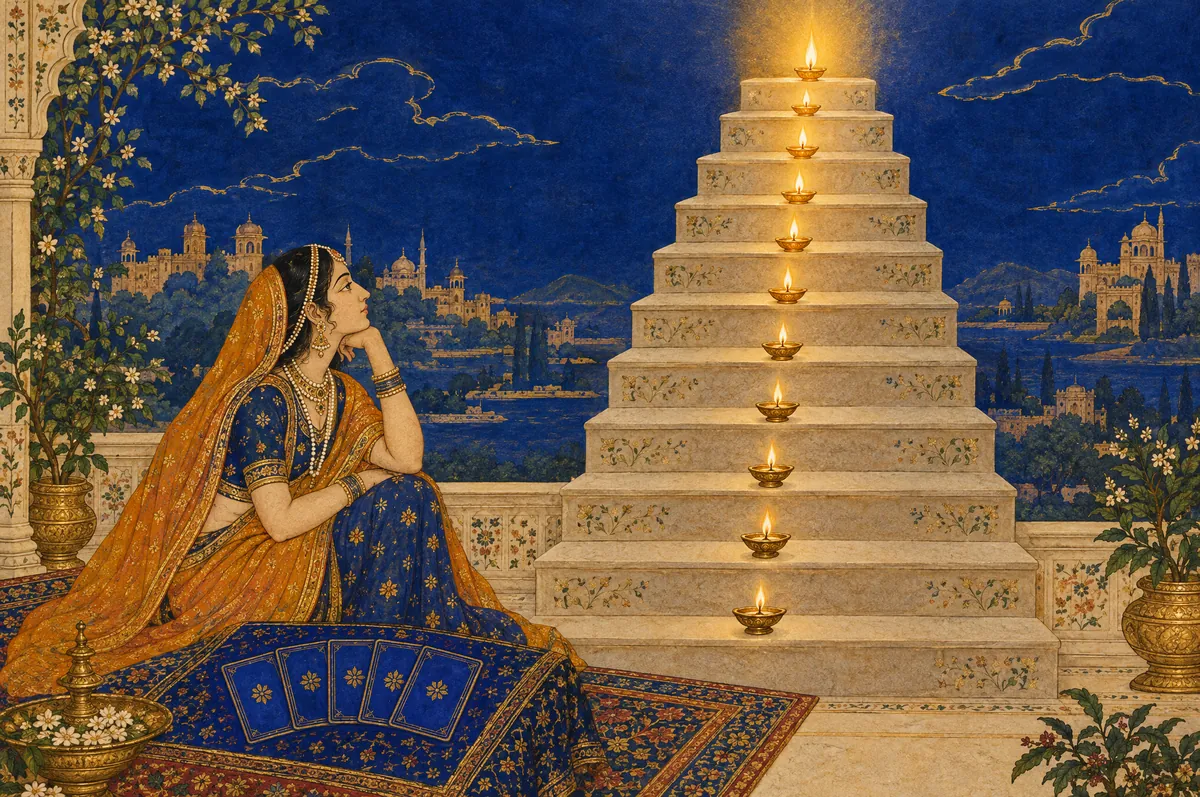
Read the numbers as stages of a single process, the way a seed becomes a harvest. TarotPandit teaches them in this order, with the Sanskrit number names used on every card page:
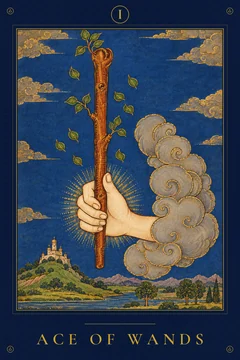
- One, the seed (Eka). The force of the suit before it has met anything. The Golden Dawn calls each Ace the root of the powers of its element.
- Two, polarity (Dvi). The force meets an other: a choice, a partner, a balance to be kept.
- Three, growth (Tri). The first result. What two began, three expresses.
- Four, structure (Chatur). The result is given walls. Stability, and with it the risk of standing still.
- Five, crisis (Pancha). The structure is shaken. Something is lost or contested so that growth can resume.
- Six, harmony (Shat). Balance regained after the shock, often through giving, receiving or moving on.
- Seven, test (Sapta). The harmony is examined. A position must be defended, a choice judged, patience proved.
- Eight, movement (Ashta). Energy is applied: speed, departure, or the steady discipline of practice.
- Nine, culmination (Nava). The suit at its fullest intensity, for good or for ill.
- Ten, completion (Dasha). The cycle closes, and the closing is the ground on which the next Ace falls.
Read the list aloud twice. You will notice a rhythm: the odd numbers after One tend to disturb (Three adds to the pair, Five breaks the Four, Seven tests the Six, Nine pushes to the limit) and the even numbers tend to settle. Treat this as a teaching device rather than a law. It explains at once why every Five feels uneasy and every Six feels like relief.
One number, four suits
Now cross each number with an element. Wands are Fire (will, enterprise, desire), Cups are Water (feeling, love, imagination), Swords are Air (thought, speech, conflict), Pentacles are Earth (body, money, work). The number says what stage the process has reached; the suit says where it is happening.
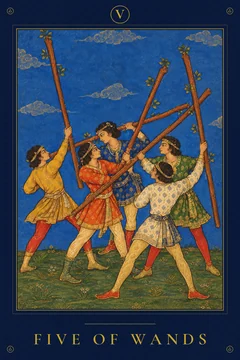
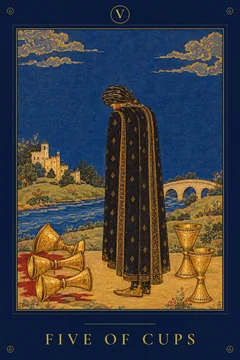
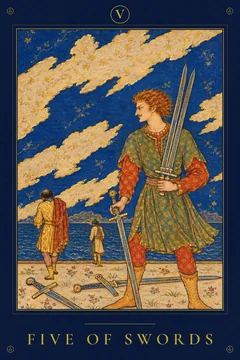
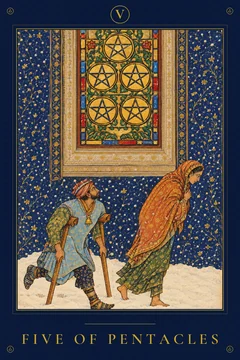
Take the Fives. In Fire the crisis is rivalry: five young men spar with staves in the Five of Wands. In Water it is grief: a cloaked figure bows over three spilt cups while two still stand behind him in the Five of Cups. In Air it is a quarrel won at too high a price, as a smiling man gathers swords and two defeated figures walk away in the Five of Swords. In Earth it is hardship: two poor travellers pass beneath a stained-glass window in the falling snow in the Five of Pentacles. Four pictures, one idea: the structure of the Four has broken.
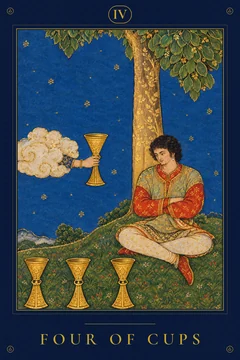
Test the Fours against the same method. The garlanded homecoming of the Four of Wands, the young man who does not see the offered cup in the Four of Cups, the knight resting on his tomb in the Four of Swords and the crowned man gripping his coins in the Four of Pentacles are all structures. In Water and Earth you can already see structure sliding into stagnation and hoarding, which is the shadow of every Four.
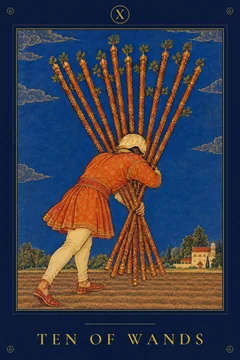
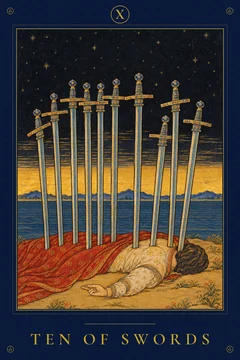
Do the Tens the same way. The Ten of Wands is completion as burden, the Ten of Cups completion as a family under a rainbow, the Ten of Swords an ending that can go no further, with first light on the horizon, and the Ten of Pentacles wealth passed between generations.
The Golden Dawn titles as a memory aid
The Golden Dawn gave every pip from Two to Ten a title of the form "Lord of ...". They are worth learning because they compress number and element into two or three words:
- Twos: Dominion (Wands), Love (Cups), Peace Restored (Swords), Harmonious Change (Pentacles).
- Threes: Established Strength, Abundance, Sorrow, Material Works.
- Fours: Perfected Work, Blended Pleasure, Rest from Strife, Earthly Power.
- Fives: Strife, Loss in Pleasure, Defeat, Material Trouble.
- Sixes: Victory, Pleasure, Earned Success, Material Success.
- Sevens: Valour, Illusionary Success, Unstable Effort, Success Unfulfilled.
- Eights: Swiftness, Abandoned Success, Shortened Force, Prudence.
- Nines: Great Strength, Material Happiness, Despair and Cruelty, Material Gain.
- Tens: Oppression, Perfected Success, Ruin, Wealth.
Two cautions. First, the titles were written for the Golden Dawn's own cards, and the 1909 images do not always agree with them. Blended Pleasure sits oddly on the Four of Cups, where Smith painted weariness and an unnoticed offer. When title and picture differ, read the picture for the 1909 deck and keep the title as a note on number and element. Second, avoid reciting a title to a querent as though it were the meaning; translate it into the querent's situation instead. The titles are scaffolding for you.
Exercise
Time: 30 minutes. Lay the forty pips in four rows (Wands, Cups, Swords, Pentacles) and ten columns (Ace to Ten).
- For each column, write in your notebook the number, its keyword from this lesson, and one sentence that is true of all four cards in that column.
- Choose the column you found hardest. For each of its four cards, write two lines on how the element bends the number.
- Shuffle the pips, draw three, and turn them face down after one glance at the corner. Rebuild each meaning from number and element alone, in writing. Then open each card page on TarotPandit and mark what you got right and what the picture adds.
Keep the page. You will use the column sentences again when you look for repeated numbers in a spread.
Quizzes, progress and the certificate come with the Practitioner licence
You are reading the free preview of the Intermediate course. The licence includes the Intermediate and Professional courses, the Practitioner Exam with a verifiable certificate, and the first year of Premium.
Refundable in full within 7 days if no lesson of the Intermediate or Professional course has been completed (refund policy).