How to read tarot cards: a complete beginner's guide
A first tarot reading from deck to conclusion: the structure of the 78 cards, how to ask a useful question, and the symbol-first method. Includes a worked three-card reading and the mistakes beginners make most often.
टैरो कार्ड पढ़ना चार आदतों पर टिका है: एक स्पष्ट प्रश्न पूछिए, ऐसा विन्यास बिछाइए जिसके हर स्थान का अर्थ हो, हर कार्ड को पहले उसके चित्र से पढ़िए, और पाठ को एक ऐसे कदम पर समाप्त कीजिए जो प्रश्नकर्ता उठा सके। 78 कार्डों में 22 मेजर आर्काना जीवन के बड़े अध्याय बताते हैं और 56 माइनर आर्काना चार सूटों में रोज़ की घटनाएँ। अच्छा प्रश्न खुला होता है, अपने ही पक्ष पर केंद्रित होता है और ऐसे विषय पर होता है जिस पर आप कार्य कर सकें। उलटा कार्ड भीतर मुड़ी, विलंबित या अधिक हो गई ऊर्जा है, बंद द्वार कभी नहीं। अर्थ रटने के बजाय प्रतिदिन एक कार्ड निकालिए, उसका चित्र देखिए और डायरी में लिखिए कि वह आपके दिन में कहाँ दिखाई दिया।
Learning how to read tarot cards comes down to four habits. Ask one clear question, lay the cards in a spread whose positions each carry a meaning, read every card by its picture before anything else, and finish with one action the person can take. The rest is practice. This guide walks you through a first reading from deck to conclusion, using the 1909 deck drawn by Pamela Colman Smith.
What you need before your first reading
A deck, a quiet surface and a notebook are enough. TarotPandit teaches from the Smith-Waite deck, published by William Rider & Son in December 1909, because every one of its 78 cards carries a painted scene. Many older decks showed the numbered suit cards as plain rows of cups or coins. Smith drew people doing things, so a beginner can read a card by looking at it.
You do not need ritual objects, a special cloth or a deck received as a gift. The idea that a first deck must be given to you is folklore, and it has kept many students waiting for no reason. Buy the deck you will use, and use it daily.
The notebook matters more than any accessory. Write down the date, the question, the cards and your reading. Return to the entry a week later and note what proved useful. That record will teach you more than any list of meanings.
Tarot for beginners: how the deck is built
The 78 cards fall into two groups.
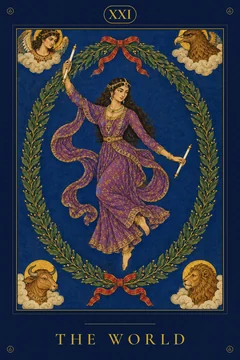
- The Major Arcana: 22 cards numbered 0 to 21, from The Fool to The World. They describe the larger chapters of a life: beginnings, tests, endings and awakenings. You can see all of them on the Major Arcana page.
- The Minor Arcana: 56 cards in four suits of fourteen. Each suit has ten numbered cards, Ace to Ten, and four court cards: Page, Knight, Queen and King.
Each suit speaks for one element and one area of experience.
- Wands are Fire: will, energy, enterprise, the work you start.
- Cups are Water: feeling, love, friendship, the inner life.
- Swords are Air: thought, speech, decisions and conflict.
- Pentacles are Earth: money, the body, work and the material world.
This structure gives you a reading before you know a single card. A spread full of Major Arcana describes a significant chapter. A spread full of Cups is about feeling, whatever the question claimed to be about. Three Swords in a love reading suggest that the difficulty lies in words and thoughts more than in the feeling itself. The full map, with every card linked, is in our guide to tarot card meanings.
Ask a question the cards can answer
A reading is only as good as its question. The most useful questions are open, centred on the person asking, and about something they can act on.
Avoid questions that hand your choices to the cards, such as "Will I get the job?" Ask instead, "What should I focus on to give myself the best chance at this job?" The first invites a verdict you cannot use. The second produces advice you can follow this week.
Avoid questions about another person's private mind, such as "Is he thinking about me?" Ask instead, "What can I understand about my part in this relationship?" The cards describe your situation more usefully than they describe someone who is not present, and your side is the only side you can change.
Avoid stacking several questions into one. Ask one question per reading, write it down before you shuffle, and keep it in front of you while you read.
How to do a tarot reading, step by step
- Settle. Sit for a minute and let the noise of the day pass. A calm reader reads more clearly.
- Write the question. One sentence, in the notebook.
- Decide on reversals. Choose before you shuffle whether you will read reversed cards. If you will, turn part of the deck around as you mix it. If you will not, keep every card upright. Either choice is sound. Changing your mind after the cards fall is not.
- Shuffle and cut. Shuffle until it feels finished, then cut the deck into three piles and restack them in any order.
- Lay out the spread. For a first reading, use three cards for past, present and future, placed left to right.
- Look before you interpret. Turn the cards over and spend a full minute only looking. What is happening in each picture? Who is moving, who is still, and where does the light fall?
- Read each card in its position. The card says what is happening. The position says where it sits in the story.
- Read the cards together. Notice how they connect, then form one sentence that holds the whole reading.
- Name one action. Every reading ends with something the person can do, think or stop doing.
- Record it. Write the cards and your reading in the notebook.
Read the picture first
Beginners often reach for a book the moment a card appears. Try the opposite. Describe what you see before you look up any meaning, because Smith painted much of the meaning into the scene.
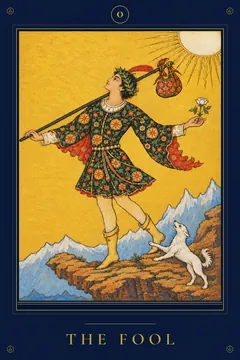
Take The Fool. A young traveller stands at the edge of a cliff with his eyes on the sky, a white rose in one hand, a small bundle on a staff and a white dog at his heel. Before any keyword, the picture tells you this is a beginning taken in good faith, with the ground not yet checked. Waite reads the figure as a spirit setting out in search of experience, and the image already says as much.
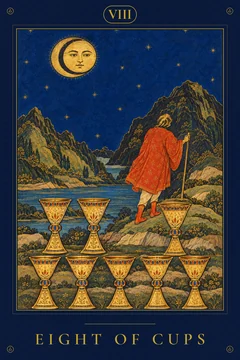
Take the Eight of Cups. A traveller in a red cloak walks away toward the mountains under an eclipsed moon, his back to eight cups stacked with a gap in the upper row. None of the cups has fallen. The card describes leaving something that is intact but no longer enough, and you can see that meaning before you read it.
Then add what the book gives you: keywords, element, number and the Golden Dawn attribution. Each card page on TarotPandit walks through the symbols of the 1909 plate one by one, so you can check your reading of the picture against the tradition.
Position and relationship
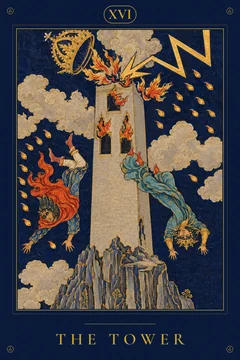
A card means something specific because of where it falls. The Tower in the past position describes a disruption already survived. The same card in the future position asks you to examine a structure in your life that may not hold, so that you can repair or replace it in good time.
Here is a worked three-card reading. The question: "How can I move forward after a disappointment at work?"
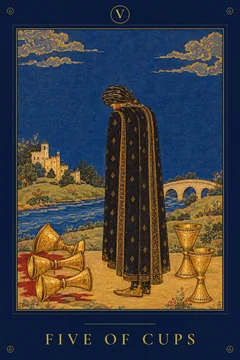
- Past: the Five of Cups. A cloaked figure mourns three spilled cups while two stand untouched behind him. The disappointment was real, and attention has stayed on what was lost.
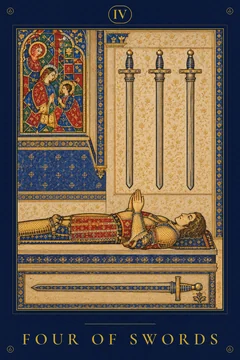
- Present: the Four of Swords. A knight lies at rest in a quiet church. The present asks for recovery: sleep, distance and a pause before the next decision.
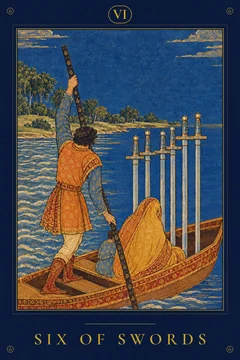
- Future: the Six of Swords. A boat carries its passengers toward a calmer shore. Movement comes gradually, once the rest has done its work.
One sentence for the whole: the loss is real, rest is the present task, and the crossing to better ground follows from it. The action: take the leave you have been postponing, and make no large decision until it is over.
Notice the patterns as well. All three cards are Minor Arcana, so the matter lives in daily choices and is not a defining life chapter. Two are Swords, so much of the work is in the mind, in how the person thinks about the loss.
Upright and reversed cards
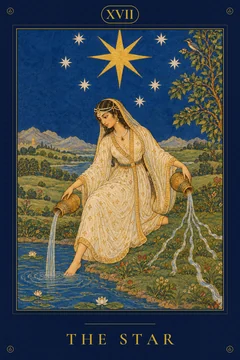
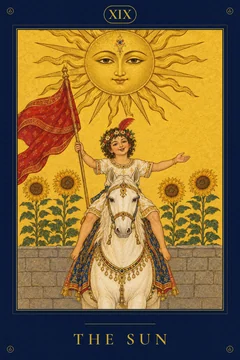
If you read reversals, a card that lands upside down does not simply mean the opposite of its upright meaning, and it never means a closed door. TarotPandit reads a reversal as the energy of the card turned inward, delayed or in excess. The Star reversed is hope still present but not yet trusted. The Sun reversed is success arriving in a smaller or slower measure.
Many readers begin without reversals and add them once the upright meanings feel familiar. That is a sensible order. Our article on reversed tarot cards covers the method in full.
Tarot card meanings: learn them by use
You do not need to memorise 78 meanings before your first reading. Learn them the way you learn a language, by using them.
Draw one card each morning with the daily reading, or work through your own deck in order, one card a day. Look at the picture, write three words it suggests, then read the card page. In the evening, note where the card showed up in your day. In seventy-eight days you will have lived with every card once, and you will remember the cards you lived with far better than the ones you only read about.
Common beginner mistakes, and what to do instead
- Redrawing until the answer pleases you. A second draw on the same question tells you less than the first. Accept the first draw and ask a better follow-up question.
- Reading out of fear. A difficult card describes a situation; it does not pass sentence. Ask what the card asks of you, and find the step in it.
- Drifting from the question. General impressions are easy to slip into. Return to the written question after each card.
- Treating health, legal or money questions as verdicts. Tarot can direct attention: rest more, read the contract again, review the month's spending. It does not replace a doctor, a lawyer or a qualified adviser. Consult them first, then use the cards to reflect on how you are meeting the situation.
- Reading only from the book. Use the book to check your reading, and begin with what you see.
Next steps
Try a three-card past, present and future reading now, with your question written down first. When you want structure and feedback, the free Foundation course teaches the deck, the symbol-first method and the craft of the question, lesson by lesson. Then read tarot card meanings for a map of all 78 cards, or yes or no tarot for quick, near-term decisions.
Questions
How do beginners start reading tarot cards?
Start with a single deck, a notebook and a three-card past, present and future spread. Write one clear question, shuffle, lay the cards, and describe each picture before looking up its meaning. End every reading with one practical action and record it in the notebook.
Do I need to memorise all 78 tarot card meanings first?
No. Learn the structure first: 22 Major Arcana for life chapters and four suits for the elements of daily life. Then meet one card a day through practice. The meanings you use stay with you far longer than the ones you memorise from a list.
Should beginners read reversed tarot cards?
It is sensible to begin with upright cards only and add reversals once the upright meanings feel familiar. Whatever you choose, decide before you shuffle and keep to it for that reading. TarotPandit reads a reversal as energy turned inward, delayed or in excess, never as a closed door.
What is the best tarot spread for beginners?
The three-card past, present and future spread. It is short enough to read in full, and it teaches the most important skill in tarot: reading a card according to its position and in relation to its neighbours.
Can I read tarot cards for myself?
Yes. Reading for yourself is how most students learn. Write the question down before you shuffle, accept the first draw rather than redrawing, and look for the action the cards suggest instead of the answer you hoped for.