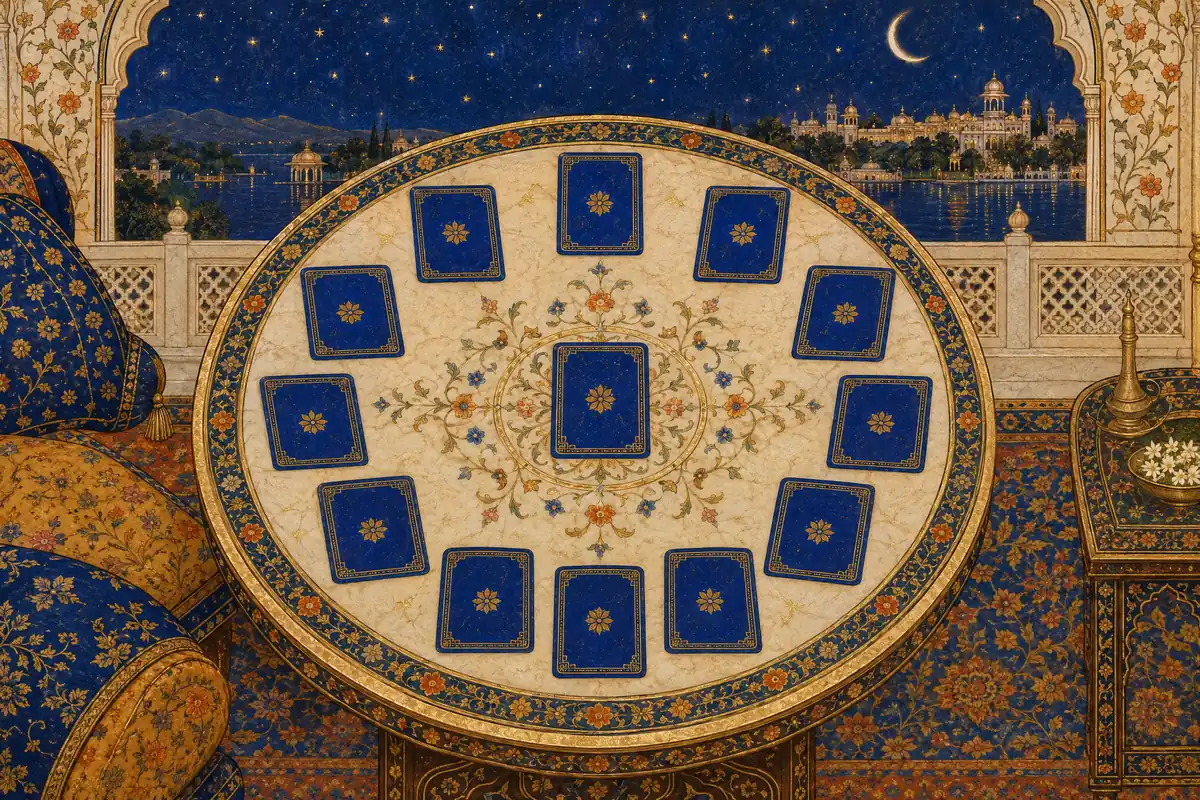
Twelve cards for the twelve months ahead, and a thirteenth for the year as a whole.
आगे के बारह महीनों के लिए बारह कार्ड, और पूरे वर्ष के लिए तेरहवाँ।
January
February
March
April
May
June
July
August
September
October
November
December
The card of the year
Premium spread
The year, month by month.
The Year ahead spread is part of Premium. Premium opens every spread, unlimited, with the five areas of life on every card and a sealed PDF of each reading.
₹299 a month, or ₹1,999 a year (save 44%), less than ₹6 a day
Each card is read in its position from the TarotPandit library: the card speaks, the position, the cards together, and practical guidance, in English and Hindi, closing with a synthesis.
The guide
When to use this spread
Lay the year-ahead spread once a year, in the last week of December or the first days of January. It gives the year a shape, showing which seasons ask for work and which for rest. It rewards the reader who writes it down and comes back to it on the first of every month. It is a poor tool for one sharp question. For a single choice use the decision spread, and for the next four weeks in finer detail use the month ahead spread. If you would rather read the year from your own birthday than from the calendar, the birthday spread runs from one birthday to the next.
The numbers match the positions listed alongside
By hand
How to lay it out
Lay twelve cards in a circle like a clock face. January goes at one o'clock and the months run clockwise, so December lands at twelve, at the top. Place the thirteenth card, the card of the year, face down in the centre and turn it last. Keep every card facing you instead of rotating it with the circle, or you will lose track of which ones are reversed. The positions carry calendar names, so if you lay the spread in June, the months already gone become a check on the reading and only the months ahead are forecast.
What each position asks
1
January जनवरी
The card that opens the year shows how you step into it, and its mood tends to echo for some weeks. Read it beside the card of the year once that is turned. If the two share an element, the year starts on its main theme; if they clash, January is a warm-up.
2
February फ़रवरी
February often carries what the old year left unfinished, a conversation or a decision put off over the holidays. A reversal here usually points to that leftover. Settling it early keeps the spring clear.
3
March मार्च
For many Indian readers March closes the financial year, so a Pentacle here often speaks of accounts and appraisals to finish. Before interpreting it alone, glance at April and May. Clusters of one suit often begin in this month.
4
April अप्रैल
April opens the new financial year and, across much of India, the first real heat. Read this card for a fresh commitment: what you sign or agree to. If it repeats the suit of March you are standing in the middle of a cluster, and the season's story outweighs the single month.
5
May मई
May is a month of hard heat and, for many families, school holidays and travel. Read its card for stamina, for how the spring's effort holds up when the pace drops. A reversal here often shows impatience with results that are still ripening.
6
June जून
June is the year's midpoint. Read it against January, as the halfway answer to how the year opened, and against the card of the year for how far its lesson has taken root.
7
July जुलाई
July falls in the heart of the monsoon in most of India, and its card often concerns inner weather: moods, and choices made in a haze. Read it for what you see plainly and what you only wish for.
8
August अगस्त
August is often the month things speed up after the slow rains. Read this card for movement, news and offers falling due. A Wand here brings pace, and a reversal asks for one clear priority before anything else is sent.
9
September सितंबर
By the end of September three quarters of the year have passed, so read this card as the year's quarterly review. A Major here, or in any month, marks a turning point larger than the month itself. Give it extra weight.
10
October अक्टूबर
Diwali falls in October or November, and with it guests and extra spending. Read October's card for load, and for what you can hand to someone else. A reversal here is often the moment a burden is set down.
11
November नवंबर
November often brings a change of direction as the year winds down. Read it for transition: what you leave on the old shore and what you carry into December.
12
December दिसंबर
December closes the circle and points into the next year. Read it beside January: a December card that answers January's card tells you the year has done its work.
13
The card of the year वर्ष का कार्ड
The thirteenth card names the lesson the whole year is teaching, and it colours every month around it. Turn it last, so the months speak in their own voices first. Then go round the circle a second time and ask of each month how it serves that lesson.
One reading, start to finish
A worked example
A 33-year-old software tester in Hyderabad, reading on the last weekend of December, who hopes to move into a product role and whose parents are moving in with her in the spring.
"What does the coming year hold for my work and my home?"
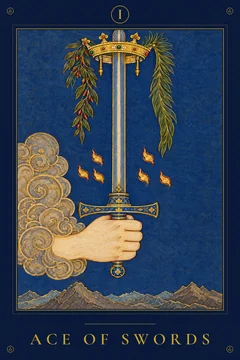
A hand from a grey cloud grips an upright sword crowned in gold, an olive branch on one side of the crown and a palm on the other. She opens the year with a clear decision: she will apply for the product role instead of waiting to be noticed. With Temperance at the centre, she should keep the olive in view beside the palm and say it kindly.
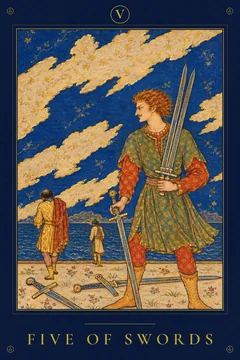
A red-haired victor gathers swords while two figures walk away toward a grey sea. Reversed, an old quarrel with her team lead is ready to be buried, and Waite himself adds burial to this card. One plain conversation closes it; after that she should stop rehearsing it in her head.
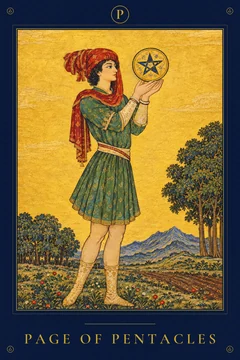
A youth in green stands in a field with a ploughed strip behind him, a pentacle held up at eye level as he studies it. March brings a course or certification she takes seriously, the first of three Pentacles in a row.
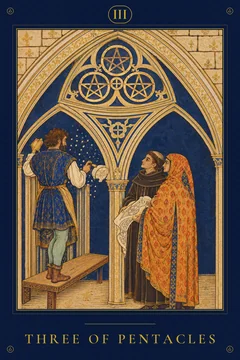
A sculptor carves a stone arch while a monk and a hooded figure hold the drawings up to him. In April her new skill is seen and used by others, perhaps on a pilot with the product team. Waite ties this card to the Eight of Pentacles, the reward of patient practice.
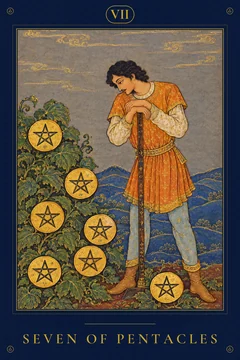
The young man leans on his hoe beside seven pentacles still on the vine. Reversed, the third Pentacle of spring shows her ready to give up because the role has not come through, just as the crop is forming. Temperance answers this card directly: slow the pour and tend it for one more season.
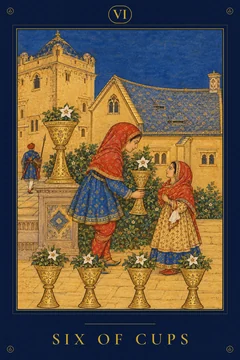
In an old courtyard a boy in a red hood bends to hand a small girl a cup of leaves and a white flower. Her parents settle into her home in June, and old stories come back to the dinner table. She can let the memories warm the household without asking the present to become the past.
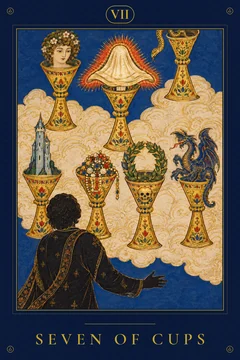
Upright, a dark figure faces seven cups floating in cloud, each holding a different vision. Reversed, Waite gives will and determination: the cloud thins and one cup comes forward. In July she chooses the one product path she wants and lets the other six go.
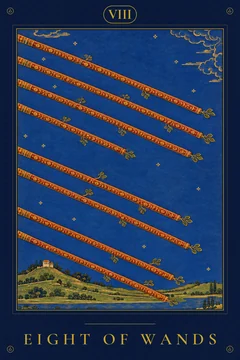
Eight flowering wands fly in parallel across open sky above green country, and no one is throwing them. August brings speed, with an interview and an offer arriving in days instead of weeks. Her part is to answer promptly.
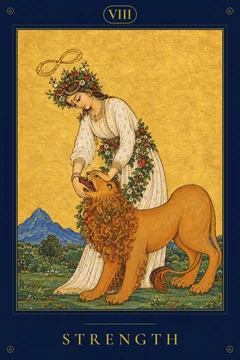
A woman in white closes a lion's jaws with calm hands, the figure-of-eight hovering above her head. She starts the new role in September under a demanding manager. Strength and Temperance are both Fire cards, through Leo and Sagittarius, so this is the month the year's lesson shows most plainly: steady gentleness holds where force would fail.
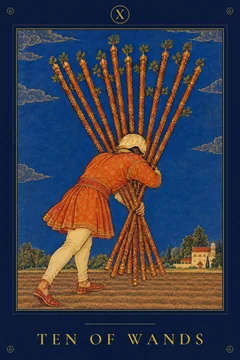
A man bent double under ten staves walks toward a house among the trees. Reversed, with a new job and the Diwali preparations piling up together, the load reaches its limit, and that is the healthier reading because it opens her arms. She keeps the staves only she can carry and hands the festival work to the family.
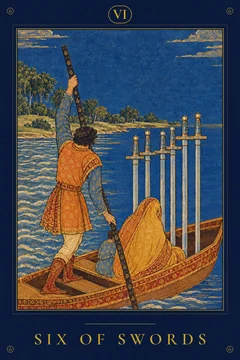
A ferryman poles a boat toward a calmer shore, a hooded woman and a child seated in front of a row of upright swords. In November she moves to quieter ground, possibly a larger flat for three adults. The troubles travel with her, though they no longer steer.
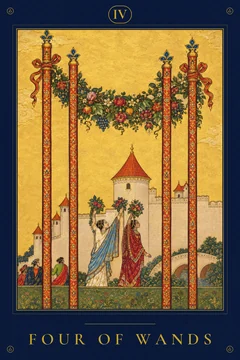
Two women raise bouquets beyond a garland strung between four wands, a castle and a bridge behind them. December closes in celebration at home. The garland answers January's sword, which tells her the year has done its work.
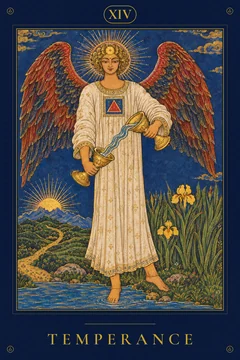
An angel stands with one foot on land and one in a pool, pouring water between two cups, while a path climbs behind to a crown of light. Temperance is right measure found by patience, and her question names two things to be blended, work and home. The year asks her to adjust both by small amounts, often, instead of choosing one.
Synthesis
Start with the centre. Temperance is the card of mixing well, and every month should be read through it: a year of measured blending between a career that is changing and a household that is growing.
Now look for clusters. March, April and May are all Pentacles, and three of one suit in a row turn single months into a season. Spring is her season of craft. It opens with study and recognition, and it closes in May with the doubt that every slow crop brings. June and July are Cups, so the summer belongs to home and feeling. The last third of the year is Fire, with Wands in August, October and December and Strength in September.
Two Sevens appear, May and July, both reversed. Seven is the number of pause and review. The first reversal is impatience, which Temperance corrects. The second is Waite's determination, the moment she chooses. Read together, they say the delay of May makes the choice of July possible.
The only Major in the circle is Strength, and it shares its element with the card of the year. September is the hinge of the whole reading.
The plain answer: the role comes, later than she wants and around August or September, and home grows fuller and warmer, with one heavy month in October. Her next step is to write each month's card at the top of that month's calendar page and, on the first of each month, read only that card beside Temperance.
Before you lay it
Common mistakes
Reading the twelve months before looking for patterns. Scan the whole circle first for runs of one suit, repeated numbers and Majors, then read month by month.
Treating the card of the year as a fourteenth opinion. It is the lens for the other twelve, so return to each month after turning it and read that month again through it.
Taking a reversed month as a lost month. A reversal shows energy delayed or turned inward, so mark that month in the diary as one for slower plans and an honest review.
Laying the spread and never looking at it again. Photograph or write it down, and on the first of every month read that month's card beside the card of the year.
Premium
The Year ahead spread and every other spread, unlimited
Can I do a year-ahead tarot reading in the middle of the year?
You can, though the positions carry calendar names. The months already past then act as a test of the reading, and only the months ahead are a forecast. If your birthday is close, the birthday spread covers the twelve months from it; otherwise lay a fresh year-ahead in late December.
What does it mean when one suit shows up three months in a row?
It marks a season. Three Pentacles point to a stretch of work and money; three Cups to feeling and family; three Swords to decisions and difficult talks; three Wands to energy and movement. Read the cluster as one story that starts in its first month and resolves in its third.
Is the card of the year in this spread the same as my TarotPandit year card?
No. The year card on your profile is worked out from your birth date and the calendar year, and it is always a Major. The card of the year in this spread is drawn, so it can be any of the 78. Read the two side by side and notice where they agree.
How does the Year ahead spread work?
You ask your question, shuffle, and choose 13 cards. Each card is read in its position, then the reading closes with a synthesis that joins them.
Is the reading free?
Today's card, yes or no, past-present-future and the Celtic Cross are free, three readings a day without an account. The other spreads are part of Premium.
What does a reversed card mean?
A reversed card is the same energy turned inward, delayed or asked for differently. TarotPandit never reads it as a closed door: every reversal names a step.
Are the readings in Hindi?
Every reading comes in English and Hindi. Use the language button to choose which leads.